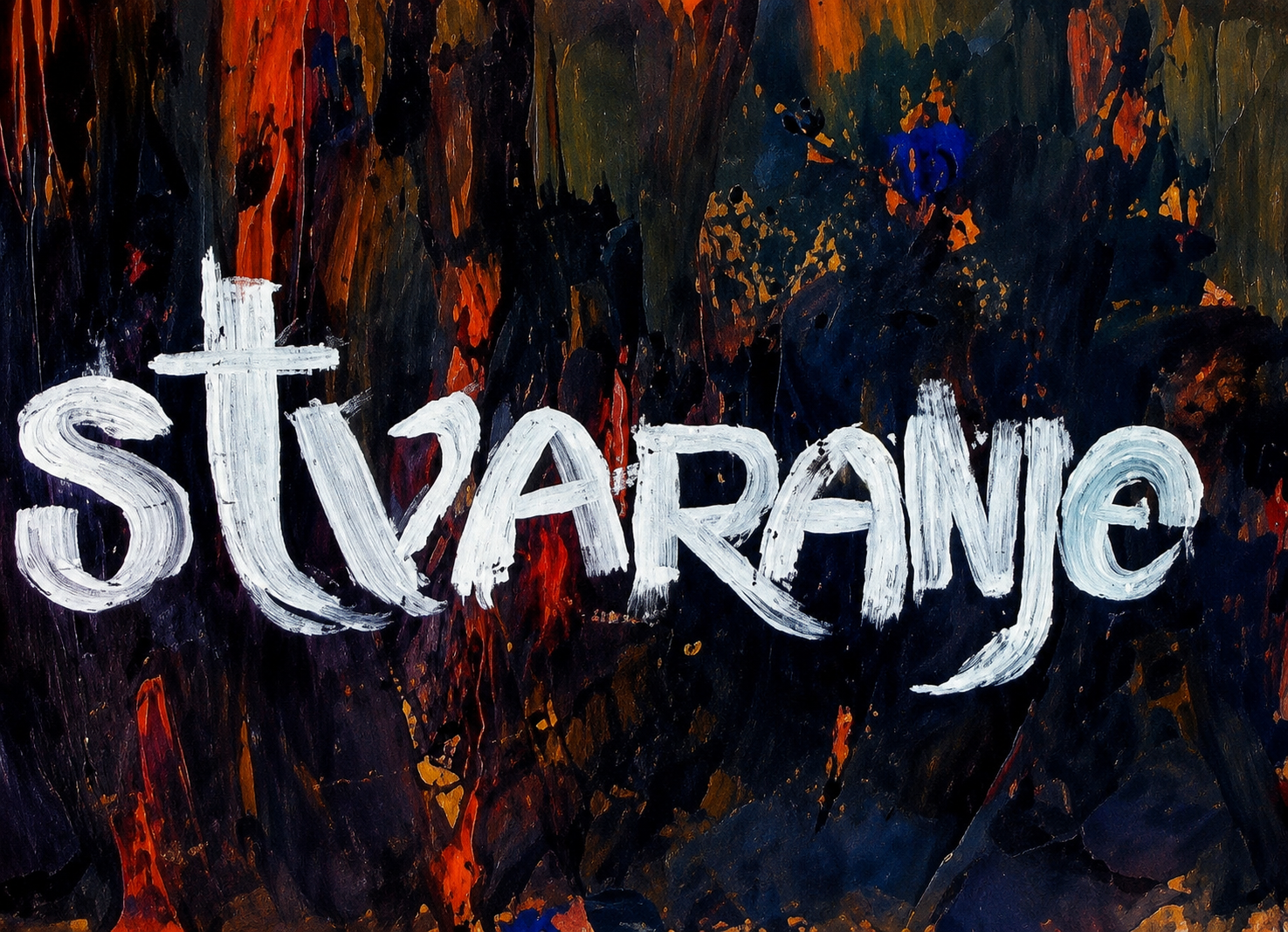
How Does an Idea Become Reality?
17.08.2026Inspired by the work of Milan Konjović, painter
Written by: Miloš Stevanović
There is a moment before every act of creation when there is still nothing. The canvas is empty. The paper is white. The space has no shape. The company has no name. The book has no first sentence. There is only an idea — sometimes clear, but much more often vague, restless and known only to the person carrying it within.
That very journey, from something that exists only in our consciousness to something that becomes part of the real world, may be the most exciting human process. Looking at the works of the great Serbian painter Milan Konjović, particularly his powerful relationship with colour, brushstroke and the very act of painting, we can understand that creation is not simply the execution of a plan prepared in advance. Creation is a process in which the idea itself changes as it comes into being.
Konjović did not paint in a way that concealed the traces of the painting’s creation. On the contrary, the energy of the brushstroke remains visible. Colour is not merely a means of depicting something; it becomes an event on the canvas. In such painting, we can feel the movement of the hand, the decision, the impulse, the correction and the moment when the artist says: now it is enough. Precisely because of this, his art can serve as a powerful metaphor for every creative process.
At the beginning there is the idea. An idea is an unusual phenomenon. At the moment it appears, it has no weight, price, address or physical form. We cannot touch it. Other people often cannot even see it in the way its creator sees it. And yet, it is precisely from such invisible beginnings that paintings, houses, cities, companies, inventions, books and entire systems emerge — things that later change people’s lives.
But having an idea is not the same as creating. Creation begins only when we make the first stroke. The painter must put colour onto the empty canvas. The writer must write the first sentence. The architect must draw the first line. The entrepreneur must take the first concrete step towards something that, at that moment, may exist only in their mind. That first stroke does not have to be perfect. Its greatest value lies in the fact that it breaks the emptiness.
After that, things begin to change. One decision produces another. One colour calls for another colour. One stroke changes the relationship of the entire composition. What initially appeared to be a mistake sometimes becomes the most important part of the painting. What we considered essential may completely disappear during the process. The creator therefore needs enough determination to follow the idea, but also enough freedom to change it.
Here lies one of the greatest differences between an idea and its realization. An idea is perfect because it has not yet been exposed to reality. Realization is valuable precisely because it has. The real world sets boundaries. There is not enough time. There is not enough money. Technical problems emerge. People do not understand the concept. Circumstances change. Something that seemed simple on paper becomes difficult in practice. And that is precisely when true creation begins.
Because a creator is not someone to whom obstacles never happen. A creator is someone who, through obstacles, continues to give shape to the original idea. Here we can find something of Konjović’s artistic energy. His canvas is not a cold mathematical construction in which every centimetre is predetermined. There is a struggle between control and spontaneity. The artist knows what he wants, but at the same time allows the work to acquire a life of its own as it develops.
The same thing happens with great life projects. When we create something over months or years, at some point the project ceases to be merely our original idea. Other people, circumstances, experiences, mistakes, coincidences and new discoveries enter into it. If we are attentive enough, we will understand that realization does not destroy the original idea — it allows it to mature.
That is why creation also requires the ability to let go. We need to discard what does not work. Repaint the part of the canvas we liked yesterday. Change the plan. Admit that a decision was not a good one. Start again. This is not a failure of the creative process. It is the creative process.
When we later look at a finished work, we almost never see everything that came before it. We see the painting on the wall, but not the empty canvas. We see the building, but not the thousands of drawings and decisions. We see a successful company, but not the years during which its founder tried to find the right model. We see the book, but not the dozens of pages the writer deleted. We see the result, but we do not see the creation.
Perhaps that is precisely why it is so important to preserve the trace of the process. Konjović’s expressiveness reminds us that beauty does not necessarily lie in perfectly concealing the way something was created. Sometimes it is precisely the traces of the brushstrokes that give a work its character. In the same way, scars, mistakes and changes of direction give character to human projects.
The most important ability of a creator, therefore, may not be talent. It is the ability to see something that does not yet exist. To stand before an empty canvas and see a painting. To stand before an empty piece of land and see a building. To look at a problem and see a company that could solve it. To observe the existing world and think: this can be different.
And then comes the much harder part — work. Day after day. Stroke after stroke. Decision after decision. Until, at some point, an almost imperceptible change occurs: what existed for months or years only as an idea now stands before us as reality.
The very word creation in our language describes this process almost perfectly. At its root lies the word thing. To create means to give existence to something that did not exist. To give thought a form. To give an idea substance. To make the invisible visible.
That is why creation is never merely an artistic category. The painter creates through an image. The architect through space. The writer through words. The entrepreneur through organization. The engineer through construction. A parent through a family. A person, ultimately, creates their own life through their choices.
And perhaps the greatest lesson that the art of Milan Konjović can offer extends far beyond painting itself: we should not be afraid of the empty canvas. An empty canvas is not a deficiency. It is a possibility. An idea is needed. The first stroke is needed. Then another. After that come corrections, doubts, new layers, wrong directions and surprises. And then, if we do not give up, comes the moment when we step back a few paces and, for the first time, clearly see what we once could only imagine.
At that point, the idea is no longer an idea.
It has become a thing. And that is — creation.
/ / /
"Standard Prva" LLC Bijeljina is a company registered in Bijeljina at the District Commercial Court in Bijeljina. Company’s activities are accountancy, repurchases of receivables, angel investing and other related services. Distressed debt is a part of the Group within which the company repurchases the receivables, which function and are not returned regularly.
Lawyer’s Office Stevanović is the leading lawyer’s office in the region with the seat in Bijeljina. The LO abbreviation represents Lawyer’s Office of Vesna Stevanović and Lawyer’s Office of Miloš Stevanović.
Contact for media press@advokati-stevanovic.com or via telephone 00 387 55 230 000 or 00387 55 22 4444.