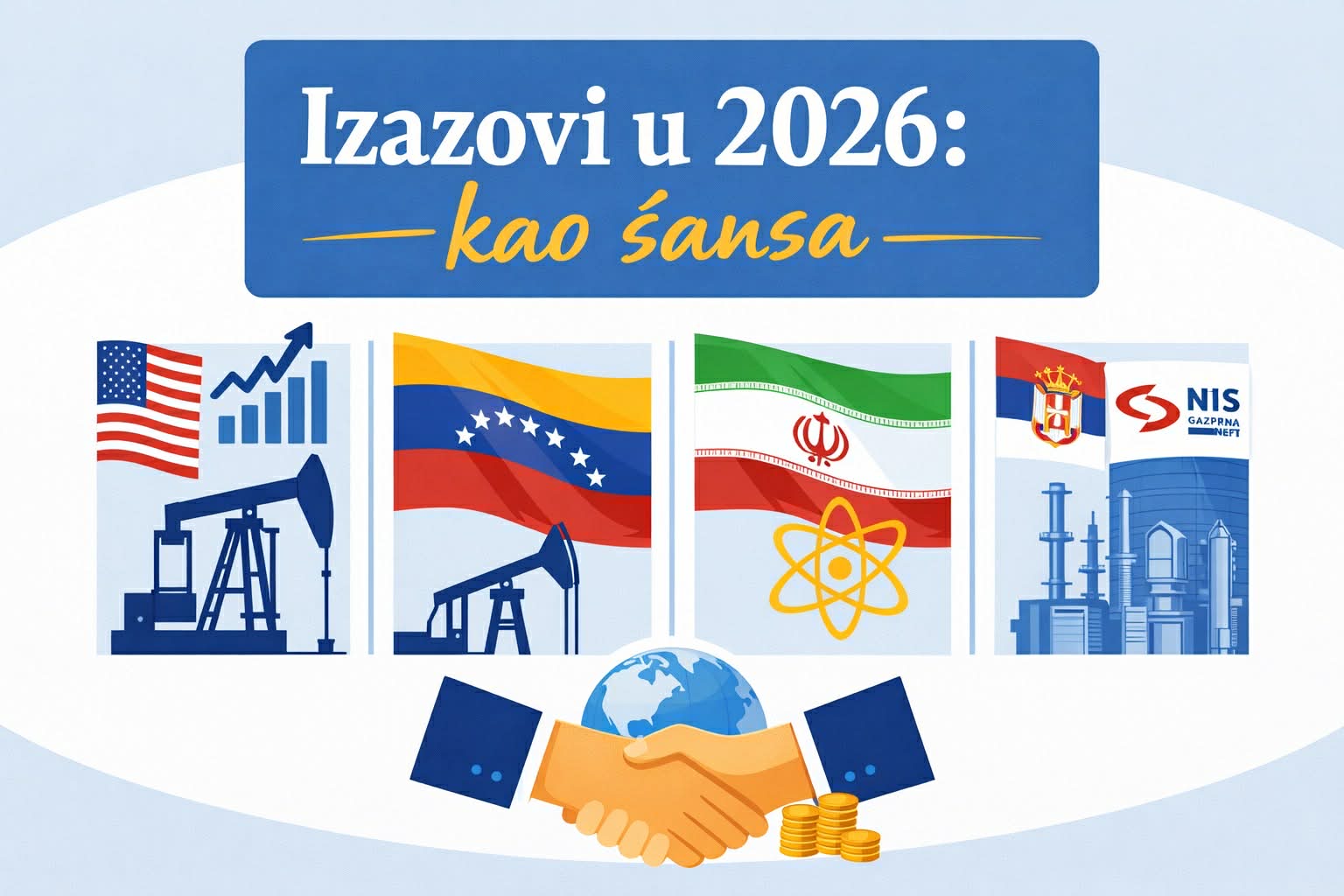
Challenges in 2026 as an Opportunity
12.01.2026The year 2026 begins under the sign of overlapping geopolitical tensions and economic shocks. The United States continues to use sanctions as a lever of foreign policy, affecting relations with countries such as Venezuela and Iran, but also indirectly impacting Serbia through its oil industry. These challenges, however, also bring unforeseen opportunities: in energy and trade, new markets and alliances are emerging that could turn crisis into opportunity in 2026.
United States: Sanctions and Energy Strategy
In recent years, Washington has imposed sanctions on three major energy producers—Russia, Iran, and Venezuela—seeking to deprive them of revenues for “undesirable” activities. Thanks to growing domestic oil and gas production, the United States has become a more influential player on the global energy market and has thus used sanctions more boldly, attempting to calibrate them carefully so as not to trigger a global price spike. Nevertheless, such measures also come at a cost: they lead to the reallocation of trade flows and the emergence of a “shadow fleet”—a network of tankers that conceal the origin of sanctioned oil and thereby maintain exports from Iran, Venezuela, and even Russia despite bans. China has become the main end buyer of these circumvented shipments, openly importing Russian oil, while purchasing Iranian and Venezuelan crude more discreetly through intermediaries.
Outlook for 2026:
The U.S. economy and companies enter the new year relatively strengthened by high domestic oil production and exporter status in natural gas. This provides opportunities for U.S. energy firms to fill gaps in the market—for example, increased LNG supply to Europe or participation in a potential recovery of Venezuela’s oil industry. The key challenge will be balancing sanctions pressure with market stability: overly harsh measures could push sanctioned countries into a tighter bloc with China and other powers, while easing sanctions without political concessions could weaken U.S. influence. In 2026, Washington will therefore continue to carefully calibrate sanctions, targeting adversaries while ensuring that global oil supply does not suffer dramatic disruptions.
Venezuela: A Path Back to the Global Stage
Prolonged U.S. sanctions have severely hit Venezuela—since 2019, the state oil company PDVSA has been almost entirely prevented from exporting oil to the open market. However, a shift occurred at the end of 2023: the U.S. administration temporarily eased restrictions, granting Caracas a six-month license to freely produce and sell oil on the global market. This decision was a reward for an agreement between the government and the opposition to hold elections in 2024 under international supervision—the most significant sanctions relief since the Trump-era “maximum pressure” policy. The license, however, comes with conditions: if President Nicolás Maduro’s regime fails to meet its commitments (such as lifting bans on opposition candidates and releasing political prisoners), sanctions can be immediately reinstated.
For now, Venezuela is optimistically inviting foreign companies to invest, claiming that “the doors are fully open” for investors after the partial lifting of restrictions. At the same time, Maduro is strengthening ties with allies: together with Iran, Venezuela has already signed a 20-year cooperation agreement in the oil, petrochemical, and defense sectors. Since 2020, Tehran has been sending fuel and refinery parts to Venezuela, helping maintain minimal production despite the U.S. blockade.
Outlook for 2026:
If the promised elections are held and relations with Washington continue to improve, Venezuela could see a gradual return of international business in 2026. Already, eased sanctions allow Western oil companies to increase activity—for example, Chevron has resumed part of its oil pumping for export. This represents a chance for economic recovery after years of isolation. However, the challenges are immense: oil infrastructure has been devastated by two decades of poor management and lack of investment, so even with sanctions lifted, Venezuela will not be able to rapidly increase production without major investments and technological assistance. Political uncertainty also remains—any deviation from agreements with the opposition could bring back old sanctions and deter investors. Thus, 2026 will be a balancing act for Venezuela between the chance for a new beginning and the risk of returning to isolation.
Iran: Sanctions Pressure and Circumventing the Rules
Unlike Venezuela, relations between Tehran and Washington enter 2026 with no signs of improvement. U.S. sanctions, intensified after Washington withdrew from the nuclear deal in 2018, continue to hit Iran’s economy—from the oil sector to finance. Iran is nominally cut off from the global oil market, but it has found ways to continue selling: Iranian oil exports reached a seven-year high in 2023, largely thanks to increased shipments to China. Through a network of intermediaries, “phantom” tankers, and ship-to-ship transfers, Tehran manages to place large quantities of oil despite U.S. sanctions.
Washington attempts to curb this through so-called secondary sanctions, punishing Chinese companies that assist Iranian trade. Thus, in October 2025, the U.S. sanctioned an independent refinery and an oil terminal in China for purchasing millions of barrels of Iranian oil “under the table.” At the same time, regional tensions complicate the picture: Iran’s support for organizations such as Lebanon’s Hezbollah and its involvement in conflicts (such as the recent Hamas–Israel war) keep the Middle East unstable and under Washington’s scrutiny. All this means that significant sanctions relief for Tehran is not in sight until a new comprehensive agreement is reached—whether on the nuclear program or regional security.
Outlook for 2026:
Iran’s economy will continue to rely on eastern markets and creative circumvention methods to survive under sanctions. On the one hand, global demand for oil remains high, providing Iran with hard-currency inflows through informal sales channels—an opportunity to maintain foreign exchange revenues and finance state spending. Even U.S. officials acknowledge they would like to see a recovery of Iran’s economy “but without nuclear weapons,” hinting at the possibility of dialogue if Tehran shows concessions. On the other hand, challenges remain severe: sanctions deter most Western investors, technology becomes outdated, and inflation and unemployment pressure the population. In 2026, Iran will face a dilemma—continue defying pressure through eastern partnerships and risk further isolation, or open the path to partial sanctions relief through limited concessions. Regardless of the choice, the business environment will remain risky, and any sudden geopolitical event (e.g., regional escalation) could further intensify pressure on Tehran.
Serbia and NIS: Between East and West
A gas station of NIS in Pančevo, Serbia (October 2025). U.S. sanctions targeting the Russian energy sector have indirectly affected Serbia through NIS, which is majority-owned by Russia’s Gazprom Neft.
For Serbia, geopolitical turmoil culminated in an unexpected economic blow: the Oil Industry of Serbia (NIS) came under U.S. sanctions due to Russian co-ownership. NIS, the country’s largest energy company, is majority-owned by Russia’s Gazprom Neft (about 56% directly and through affiliated companies). Although Serbia nominally aspires to EU membership, it refused to impose sanctions on Russia after the 2022 Ukraine crisis—partly due to its near-total dependence on Russian gas and oil. As a result, when the U.S. expanded sanctions on the Russian energy sector in early 2025, NIS was included. Washington delayed full enforcement for months, giving Serbia time to respond, but sanctions took effect in October 2025.
The consequences were immediate: international banks stopped processing payments for NIS, and Croatia’s JANAF oil pipeline suspended crude deliveries to the Pančevo refinery. President Aleksandar Vučić warned that the refinery would shut down and the country would run out of fuel unless a solution was found quickly—“when you impose sanctions on Russian companies, they also hit our country,” Vučić warned. He estimated that national fuel reserves were sufficient for only a few months of normal consumption.
To avoid the worst-case scenario, the Serbian government initiated urgent restructuring of NIS ownership. The U.S. demand is clear: a complete withdrawal of Russian capital from the company. Vučić set a 50-day deadline (from November 2025) for Russian shareholders to sell their stake; otherwise, the state announced it would take over operational control and potentially buy out the Russian share. NIS placed the refinery in “hot standby”—temporary shutdown with the ability to restart quickly once a new oil supplier is secured. During the winter, Serbia has been urgently seeking alternative crude oil and fuel suppliers, relying on additional imports to avoid shortages.
Outlook for 2026:
The NIS situation represents both a turning point and an opportunity for Serbia. If the Russian stake is successfully sold (to domestic or Western investors) and NIS is removed from the sanctions list, Serbia could stabilize supplies and avoid an energy crisis. In the long term, this could open the door to refinery modernization with Western partners and reduce dependence on a single source. Strengthening energy ties with the EU could also bring investments in renewables and storage capacity.
However, challenges are significant: finding a buyer for the Russian stake under political pressure and tight deadlines (February 2026) is difficult, and any delay increases the risk of fuel shortages and financial collapse of the company. Even after ownership changes, NIS will face market uncertainty—diversifying oil supply may require importing more expensive non-traditional blends or investing in logistics. In addition, Serbia will have to urgently seek alternatives to Russian gas in the long run, as its near-total reliance on the TurkStream pipeline leaves the country vulnerable. In 2026, balancing between East and West becomes a necessity for Serbia: the outcome of the NIS case will determine whether sanctions turn into an opportunity for an energy shift, or into a prolonged crisis weighing on the country’s business environment.
Conclusion
Globally, relations between the United States, Venezuela, Iran, and Serbia (through NIS) illustrate how geopolitics and economics are inseparably intertwined at the start of 2026. Sanctions as an instrument of power have created new alliances: Tehran and Caracas have drawn closer to each other (and to Beijing) in search of an exit from isolation, while Belgrade has been forced to redefine its energy direction under transatlantic pressure. Yet within all these challenges, opportunities are also emerging. Venezuela gains a chance for economic recovery through controlled reopening to the world, Iran sustains its financial pulse by selling oil to energy-hungry Asian markets, and Serbia can strengthen its long-term energy security through diversification. For the United States, 2026 will be a year of attempting to prove that strategic sanctions can achieve political goals without causing lasting economic damage to the global system. Each actor will face a test of resilience—but also the possibility of turning challenges into opportunities, whether by changing course or strengthening their position in the new mosaic of global relations.
Sources: Al Jazeera, Reuters, Atlantic Council
/ / /
"Standard Prva" LLC Bijeljina is a company registered in Bijeljina at the District Commercial Court in Bijeljina. Company’s activities are accountancy, repurchases of receivables, angel investing and other related services. Distressed debt is a part of the Group within which the company repurchases the receivables, which function and are not returned regularly.
Lawyer’s Office Stevanović is the leading lawyer’s office in the region with the seat in Bijeljina. The LO abbreviation represents Lawyer’s Office of Vesna Stevanović and Lawyer’s Office of Miloš Stevanović.
Contact for media press@advokati-stevanovic.com or via telephone 00 387 55 230 000 or 00387 55 22 4444.