StandardPrva responds and has long been pointing out: it is necessary to reduce bank regulation.
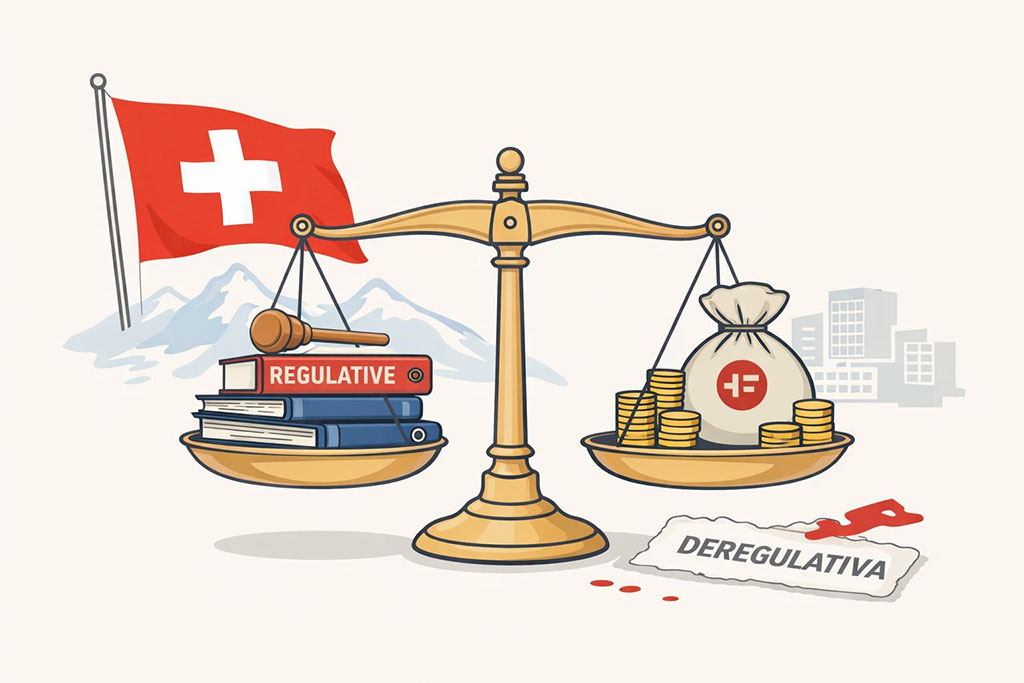
10.03.2026The debate on the regulation of the banking sector has been reopened in Switzerland. After the collapse of Credit Suisse in 2023 and its takeover by UBS, the Swiss authorities are considering a new package of regulatory measures that should further strengthen the stability of the financial system. However, some banks and financial experts warn that excessive regulation could have the opposite effect – reducing the competitiveness of the Swiss financial sector.
According to Christel Rendu de Lint, CEO of the Swiss bank and asset manager Vontobel, there is a real risk that excessive regulatory pressure could weaken Switzerland’s position as one of the leading global financial centers. She warned that it is important to find a balance between system stability and the international competitiveness of the financial industry.
New regulatory requirements after the Credit Suisse crisis
The Swiss government is preparing a reform of the so-called “too big to fail” regime, which applies to systemically important banks. One of the proposed measures is that UBS must fully capitalize its foreign subsidiaries, which could increase the required capital by as much as 24–26 billion dollars.
The banking sector believes that such requirements may be excessive. UBS executives have warned that overly high capital requirements could reduce the global competitiveness of Swiss banks and make it more difficult for them to operate compared with financial centers such as London or New York.
Some industry representatives went even further, stating that overly strict regulation could even force UBS to consider relocating part of its operations outside Switzerland.
Global trend: from regulation to deregulation
Interestingly, this debate is taking place at a time when some major economies – primarily the United States and the United Kingdom – are considering easing or postponing certain banking rules, particularly those from the Basel III package. For this reason, Swiss banks warn that unilateral tightening of regulations could lead to a loss of competitiveness for Switzerland’s financial center.
Lesson for Republika Srpska and the Federation of Bosnia and Herzegovina
This discussion is also particularly relevant for countries in the region, including Republika Srpska and the Federation of Bosnia and Herzegovina. In Bosnia and Herzegovina, the banking sector operates in a highly regulated environment – with strong supervision from the entity banking agencies, the central bank, and a wide range of European and international standards.
However, economies such as Republika Srpska and the Federation of Bosnia and Herzegovina face an additional challenge:
- the banking sector is relatively small,
- the capital market almost does not exist,
- financing of the economy comes predominantly from banks.
In such circumstances, excessive regulation can lead to several negative consequences:
- Reduced lending activity – banks become more cautious and provide less funding to the economy.
- More expensive loans – higher regulatory costs are passed on to clients.
- Less competition – foreign investors from the financial sector avoid markets with complex regulatory frameworks.
Therefore, the Swiss experience shows that even the most stable financial countries are considering how to reduce regulatory burdens without endangering system stability.
Conclusion
StandardPrva has long been pointing to the need to rationalize banking regulation in the region. The goal must not be only the stability of the financial system, but also its development and its ability to finance the economy.
The debate currently taking place in Switzerland clearly demonstrates one important fact:
excessive regulation can be just as dangerous as insufficient regulation.
For Republika Srpska and the Federation of Bosnia and Herzegovina, this means that the time has come for a serious analysis of the regulatory framework of the banking sector – with the goal of ensuring a stable but also dynamic financial system capable of supporting long-term economic growth.
/ / /
"Standard Prva" LLC Bijeljina is a company registered in Bijeljina at the District Commercial Court in Bijeljina. Company’s activities are accountancy, repurchases of receivables, angel investing and other related services. Distressed debt is a part of the Group within which the company repurchases the receivables, which function and are not returned regularly.
Lawyer’s Office Stevanović is the leading lawyer’s office in the region with the seat in Bijeljina. The LO abbreviation represents Lawyer’s Office of Vesna Stevanović and Lawyer’s Office of Miloš Stevanović.
Contact for media press@advokati-stevanovic.com or via telephone 00 387 55 230 000 or 00387 55 22 4444.