
STANDARDPRVA ANLYSIS | WORLD ECONOMY AND EDUCATION How Are Ivy League Universities Navigating the Trump Administration?
24.10.2026America’s most prestigious universities are facing one of the most complex institutional challenges in their modern history. As President Donald Trump’s administration demands changes to governance, funding and university policies, academic institutions are trying to balance the need to preserve independence, protect research programmes and cooperate with the federal government.
Universities Worth Billions, Yet Dependent on the State
When people think of Harvard, Yale, Princeton, Columbia, Cornell, Brown, Dartmouth and the University of Pennsylvania, they think of academic prestige, wealthy alumni, enormous endowments and the education of future political, business and scientific leaders.
Yet behind their reputations and financial strength lies a complex business model. These institutions hold substantial assets, but they also depend on federal research grants, private donations, tuition fees, international students and income generated by investment funds.
That dependence has become central to their relationship with the Trump administration.
Since Donald Trump returned to the White House in January 2025, the federal government has intensified its scrutiny of universities, particularly regarding antisemitism, racial discrimination, diversity, equity and inclusion (DEI) programmes, freedom of expression and the handling of student protests.
The administration argues that institutions receiving taxpayers’ money must consistently comply with federal civil-rights laws. Universities, meanwhile, warn that science funding must not become a tool for the executive branch to dictate academic positions, curricula or internal governance.
The conflict has grown into a question that extends beyond education: where does legitimate state oversight of funding end, and interference with institutional autonomy begin?
Harvard: Resistance Through the Courts
Harvard has become the most prominent example of legal opposition to the administration’s demands.
After the university rejected some federal demands to change its policies, the administration suspended or terminated billions of dollars in research funding during 2025.
Harvard responded with lawsuits, arguing that the federal government was penalising the institution for protected expression and for refusing politically motivated demands.
In September 2025, a federal court ruled in Harvard’s favour in the funding dispute. However, the proceedings are not over. On 5 October 2026, a federal appeals court considered the administration’s arguments concerning the cancellation of more than $2 billion in research grants.
The case also involves an important procedural question: whether jurisdiction belongs to an ordinary federal court or to the court specialising in monetary claims against the United States.
Harvard’s approach shows that substantial financial resources and strong legal capacity allow a university to engage in prolonged disputes with the federal government. Court protection, however, does not automatically eliminate uncertainty in research planning, recruitment or future funding.
Columbia: Compromise as a Business Decision
Unlike Harvard, Columbia University opted for a negotiated resolution.
In July 2025, Columbia reached an agreement with the US government under which it would pay $200 million over three years, plus an additional $21 million to resolve proceedings before the federal equal-employment-opportunity commission.
In return, the university was able to restore most of the research grants that had previously been suspended and regain access to future federal funding.
Columbia said the agreement preserved its authority over faculty selection, student admissions and academic decisions.
From a business perspective, the decision can be viewed as risk management. The university accepted a substantial financial obligation to reduce uncertainty and protect the continuity of its research activities.
The compromise nevertheless raises a long-term question: can institutional autonomy be fully preserved when continued funding depends on an agreement with the executive branch?
Brown and Cornell: Negotiations, Concessions and Research Protection
Brown University and Cornell University chose a different approach from Harvard, seeking agreements that would make funding more predictable and protect their core academic activities.
In July 2025, Brown reached an agreement committing it to allocate $50 million over ten years to workforce-development programmes in Rhode Island. Importantly, this was not a penalty paid to the federal government; it was funding for regional employment and education programmes.
The agreement enabled federal research funding to resume, including support for medical and health research. Brown emphasised that the government had no authority to dictate the content of university teaching or academic speech.
In November 2025, Cornell accepted financial commitments totalling $60 million. Of that amount, $30 million was allocated to the federal government, while a further $30 million was earmarked for agricultural research.
In return, the agreement enabled research funding to resume, subject to obligations to provide certain information and monitor compliance with non-discrimination regulations.
These examples show how universities are trying to turn political and regulatory uncertainty into concrete, time-limited commitments.
University of Pennsylvania: Changing the Rules Without a Prolonged Conflict
The University of Pennsylvania became the focus of a different dispute, concerning rules for transgender athletes competing in women’s university sports.
During 2025, the administration suspended approximately $175 million in federal funding, while the Department of Education pursued a case concerning the application of Title IX.
In July 2025, the university concluded an agreement committing it to apply the federal interpretation of the regulations and university-sport rules then in force.
Penn also emphasised that, in earlier competitions, it had followed the NCAA rules that were in effect at the time.
This case illustrates how quickly changes in the regulatory framework can affect an institution’s operations, even when a dispute concerns a relatively narrow area of activity.
What Lies Behind the Conflict?
A review of publicly announced agreements:
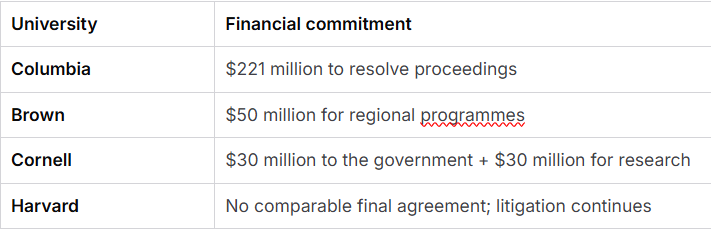
These financial commitments are not equivalent: some are settlements with the state, while others are investments in specific programmes.
From a corporate-governance perspective, the current relationship between Washington and the universities reveals three interconnected problems.
First, concentration of financial risk. Even institutions with large endowments can be vulnerable when an important share of their research depends on a single funder. University assets are not necessarily cash that can be freely spent, and many donations are restricted to specific purposes.
Second, institutional autonomy. The federal government has legitimate authority to oversee compliance with the law and funding conditions. At the same time, constitutional protections for freedom of expression and academic freedom place limits on how that authority may be exercised.
Third, reputational risk. A university that accepts a compromise may reduce financial uncertainty but face criticism from some faculty, students and donors. A university that rejects an agreement may preserve its principled position but expose researchers to prolonged financial and legal difficulties.
International Students as an Additional Challenge
Alongside research funding, US universities face uncertainty over immigration rules.
In September 2026, a federal court temporarily blocked a rule that would have changed the system governing the permitted length of stay for certain categories of international students and academic researchers.
The decision preserved the existing framework while proceedings continue, but it did not finally resolve the dispute.
For universities that attract students and researchers from around the world, predictability in visa rules is an important factor in long-term planning.
Uncertainty may affect applicants’ decisions about where to study, international research projects and institutions’ ability to attract highly qualified professionals.
Are Universities More Than Educational Institutions?
One important lesson from this conflict is that modern universities also operate as large economic organisations.
They manage capital, real estate, research centres, intellectual property, investment portfolios and international partnerships.
Their governing boards must make decisions that satisfy academic, legal, financial and reputational criteria at the same time.
In this environment, relations with the state cannot be left solely to political judgement. They require serious risk management, independent legal analysis, long-term financial projections and clear communication with all stakeholders.
In August 2026, a former US Department of Justice lawyer also filed a complaint alleging that some university investigations had been politically directed and conducted without an adequate evidentiary basis. These are whistleblower allegations, not facts finally established by a court.
This further underscores the importance of transparent procedures and independent judicial review.
StandardPrva Conclusion: Autonomy Has an Economic Cost
The conflict between Ivy League universities and the Trump administration shows that even institutions with centuries of tradition, international standing and billions of dollars in assets are not fully protected from changes in the political and regulatory environment.
Their responses have differed. Harvard has used legal mechanisms to defend its interests; Columbia accepted a financial settlement; and Brown and Cornell pursued agreements intended to protect research and ensure continuity.
From StandardPrva’s perspective, the most important business lesson is not which model each university chose, but that long-term institutional stability requires financial resilience, legal certainty and clearly defined boundaries of governance.
For business systems, financial institutions and large organisations around the world, this is a reminder that reputation and capital are valuable resources, but they cannot replace sound risk management.
American universities are debating public money, discrimination, freedom of speech, international competitiveness and the role of the state in education.
Behind all these issues lies a question that will remain important even after the current court cases conclude: how can an institution preserve independent decision-making while remaining accountable to those who fund it?
That question is relevant not only to American universities, but to every large organisation seeking to create lasting value.
/ / /
"Standard Prva" LLC Bijeljina is a company registered in Bijeljina at the District Commercial Court in Bijeljina. Company’s activities are accountancy, repurchases of receivables, angel investing and other related services. Distressed debt is a part of the Group within which the company repurchases the receivables, which function and are not returned regularly.
Lawyer’s Office Stevanović is the leading lawyer’s office in the region with the seat in Bijeljina. The LO abbreviation represents Lawyer’s Office of Vesna Stevanović and Lawyer’s Office of Miloš Stevanović.
Contact for media press@advokati-stevanovic.com or via telephone 00 387 55 230 000 or 00387 55 22 4444.