The Strait of Hormuz: The World’s Energy Artery and Europe’s New Diplomatic Challenge
14.03.2026The Strait of Hormuz represents one of the most important geopolitical and energy corridors in the world. This narrow maritime channel lies between Iran in the north and Oman and the United Arab Emirates in the south, connecting the Persian Gulf with the Indian Ocean. Through this relatively small space passes an enormous amount of the world’s energy—an estimated 20% of global trade in oil and liquefied natural gas (LNG) moves through the Strait of Hormuz.
Because of this strategic importance, any political or military tension in the region has a direct impact on global energy markets, oil prices, and the stability of the world economy.
Why the Strait of Hormuz is crucial
The Strait of Hormuz is only about 33 kilometers wide at its narrowest point, while the navigation routes for ships are even narrower. Tankers transporting energy resources from some of the world’s largest oil producers pass through it every day, including:
• Saudi Arabia
• Iraq
• Kuwait
• United Arab Emirates
• Qatar
These countries supply energy to Europe, Asia, and the United States. For this reason, the passage is often called the “energy choke point of the world”—any blockade or destabilization could cause a global disruption in energy supply.
A new geopolitical context
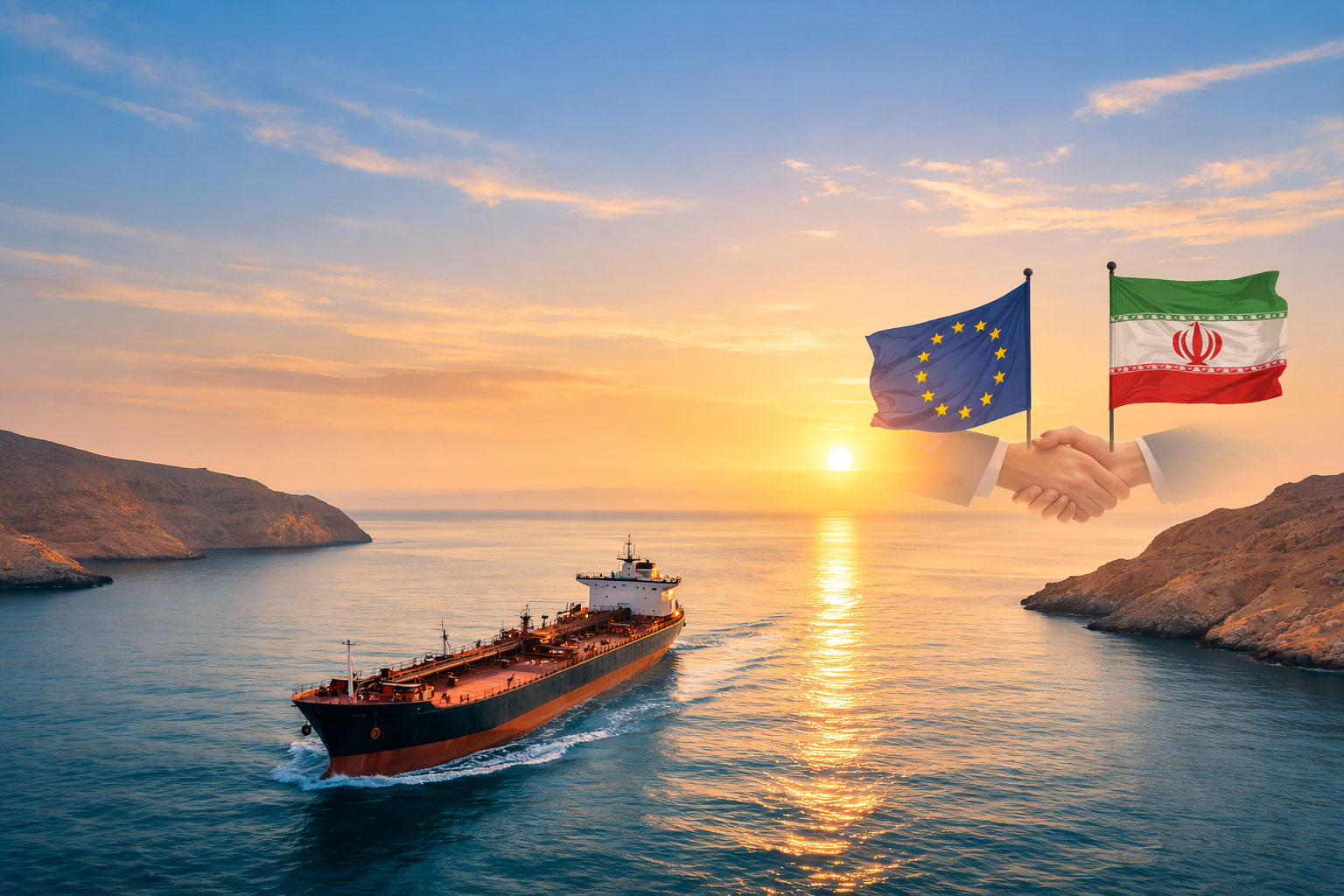
According to information published by European diplomatic sources, several European states have opened informal talks with Iran in order to secure safe passage for ships through the Strait of Hormuz.
The initiative comes after a serious deterioration of the security situation in the region, including:
• attacks on tankers
• threats to close the strait
• growing tensions between Iran and Western countries
It is particularly significant that the new Iranian supreme leader, Mojtaba Khamenei, has emphasized the possibility of continuing the blockade of the strait, which further increases concern in Europe.
The European diplomatic initiative
According to available information, France and Italy are among the states that have initiated contacts with Tehran.
The goal of these discussions is relatively pragmatic: to allow ships of countries that are not directly involved in the conflict to pass freely through the Strait of Hormuz.
In other words, Europe is trying to find a limited diplomatic solution that would allow the continuation of energy trade without further escalation of the conflict.
Italian Defense Minister Guido Crosetto emphasized that Europe is trying to act in a unified manner and that a formal agreement is being sought that would allow the passage of ships from countries that are not at war.
Fear of an energy crisis
The main reason for European diplomatic activity is fear of a new energy crisis.
In the last several months:
• the price of oil has risen from approximately 60 dollars to around 100 dollars per barrel
• the price of natural gas in Europe has increased by about 75%
European economies, which are already facing slower growth and inflation, are particularly sensitive to such shocks in the energy market.
For this reason, European governments are trying to avoid a scenario in which the Strait of Hormuz would be closed for a longer period.
The military option—but only as a last resort
European countries have warships in the region as part of the EU mission Aspides, which operates in the Red Sea with the aim of protecting commercial vessels.
However, European officials clearly emphasize that they are currently not prepared to militarily escort tankers through the Strait of Hormuz if there is a real risk of attack.
Such a move could lead to a direct escalation of conflict between the West and Iran.
French President Emmanuel Macron emphasized that France could participate in escorting ships only if the situation calms down and de-escalation of the conflict occurs.
A divided Europe
Within the European Union there is no completely unified position on how to approach Iran.
Some European states believe that direct communication with Tehran is necessary in order to prevent an energy crisis. Other countries, however, believe that such talks could weaken political pressure on Iran.
The United Kingdom, for example, is currently not conducting direct negotiations with Iran, but is talking with Persian Gulf states about the stability of energy supply.
The broader geopolitical picture
The Strait of Hormuz has for decades been one of the most sensitive points of global geopolitics.
Iran has repeatedly threatened in the past to close it in response to sanctions or military pressure from the West. Although a complete blockade has never occurred, any such scenario has the potential to trigger:
• a global surge in energy prices
• disruption of international trade
• expansion of regional conflict
For this reason, international diplomacy regularly returns to the question of freedom of navigation through this strategic passage.
Instead of a conclusion
The Strait of Hormuz remains one of the key points of global energy security. The current diplomatic attempts by European countries to reach an agreement with Iran show how important the stability of this passage is not only for the Middle East region, but also for the economic stability of Europe and the world.
In the coming months it will become clear whether negotiations will lead to a compromise that will allow the normal flow of energy resources, or whether the Strait of Hormuz will once again become the epicenter of a major geopolitical crisis.
/ / /
"Standard Prva" LLC Bijeljina is a company registered in Bijeljina at the District Commercial Court in Bijeljina. Company’s activities are accountancy, repurchases of receivables, angel investing and other related services. Distressed debt is a part of the Group within which the company repurchases the receivables, which function and are not returned regularly.
Lawyer’s Office Stevanović is the leading lawyer’s office in the region with the seat in Bijeljina. The LO abbreviation represents Lawyer’s Office of Vesna Stevanović and Lawyer’s Office of Miloš Stevanović.
Contact for media press@advokati-stevanovic.com or via telephone 00 387 55 230 000 or 00387 55 22 4444.