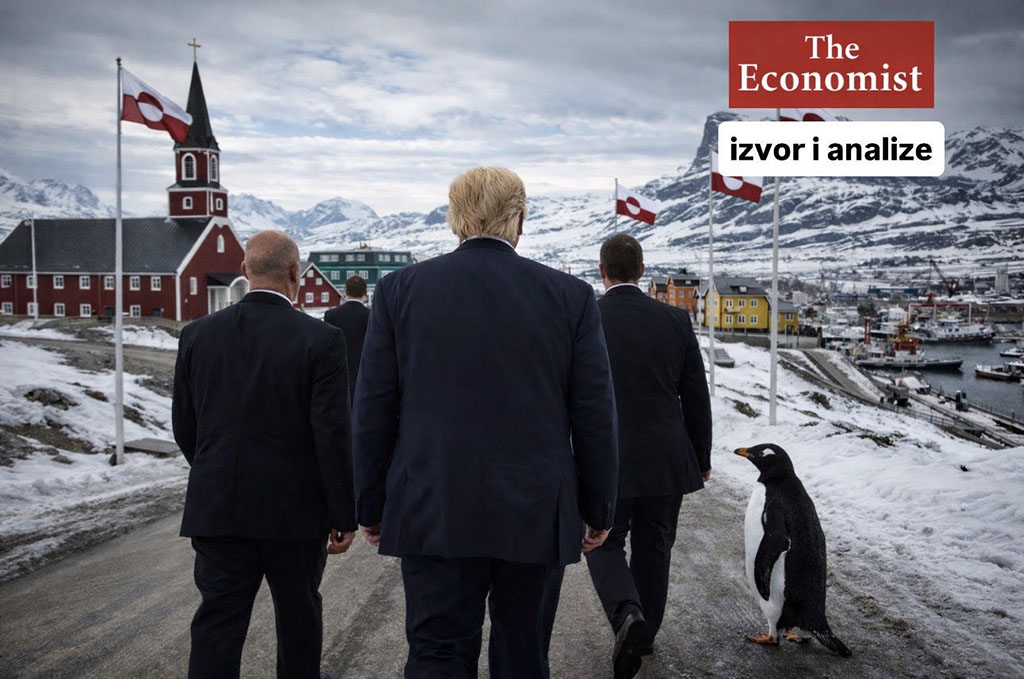
American Alliances in Danger: Greenland Is Only the Beginning
25.01.2026Introductory Editorial | StandardPrva
In a time of accelerated geopolitical shifts, the stability of the international order increasingly depends on the political impulses of individuals, and ever less on long-term, institutionally built frameworks. Relations between the United States and its traditional allies today find themselves at a turning point that goes beyond daily politics and short-term disputes.
The question of Greenland, which has been presented to the public as an isolated episode, in essence opens a much deeper debate: about the future of alliances, about the meaning of collective security, and about whether global power can be maintained without trust and shared values. For Europe, but also for small and medium-sized states that depend on a stable international environment, these are not abstract topics — but issues of direct economic, political, and security safety.
StandardPrva presents this analysis in order to point out that current events are not passing incidents, but symptoms of a deeper change in the way power is understood and used. Understanding these processes is crucial not only for decision-makers, but also for the business community, investors, and institutions that plan under conditions of increasingly pronounced global uncertainty.
American Alliances in Danger: Greenland Is Only the Beginning
StandardPrva – Geopolitical Analysis
Analysis based on a text published in The Economist, January 2026.
European leaders at this year’s World Economic Forum in Davos expected yet another open attack by Donald Trump on the traditional allies of the United States. Instead, the American president appeared significantly more conciliatory. He abandoned direct threats of force regarding Greenland, temporarily withdrew announced tariffs, and spoke of a new “framework of cooperation,” leaving room for an agreement.
At first glance, it seemed that yet another potential transatlantic crisis had been avoided. However, the key question remains: is this a lasting change of course, or merely a short pause?
Tactical retreat, not a change of strategy
Trump’s retreat on the issue of Greenland more closely resembles tactical maneuvering than a substantive change in his worldview. His attitude toward alliances has for years been characterized by deep mistrust. In this view, alliances are not an expression of shared values and long-term stability, but transactional relationships in which America, according to his interpretation, gives too much and gets too little.
Such an approach gradually erodes the foundation of trust on which American global power was built over decades.
Greenland, in this context, is a symbol rather than a goal in itself. Although the island has a significant geostrategic role — due to the Arctic, future shipping routes, and missile defense — it is already firmly integrated into the Western security system. The United States has a military base there, and Denmark and European allies have a strong interest in Greenland remaining stable and protected.
The idea that formal “appropriation” of Greenland would bring a decisive strategic advantage is more a political message than a real security necessity.
Europe reacted more decisively this time
In this episode, Europe was lucky — but it also learned a lesson. Unlike in earlier situations, European leaders did not rely exclusively on quiet lobbying and diplomatic restraint. This time, they clearly indicated that American pressure could carry a concrete cost: from trade countermeasures to political resistance.
Financial markets reacted quickly, indicating how much damage a trade war and a security crisis could inflict on America itself. At the same time, the first signs of resistance to the president’s most radical ideas appeared in the U.S. Congress.
The message was clear: when confronted with real costs of his actions, Trump is inclined to retreat.
The core problem: the attitude toward alliances
However, this is where the positive signals end. Trump’s fundamental belief remains unchanged — that alliances, and especially NATO, are a long-term burden for America. His administration increasingly speaks of the “civilizational weakening of Europe,” exaggerates the financial burden of American military protection, and ignores the fact that alliances are a two-way system of benefits.
It is true that European countries have invested too little in defense for decades. But NATO was never just a financial arrangement. Its strength derived from shared interests and values — democracy, freedom, and collective security.
During the Cold War, Europe was the key line of defense against Soviet expansion. Today, European states provide the United States with a network of military bases, logistical infrastructure, and intelligence capabilities that enable American power projection across the world, including the Arctic.
Consequences of withdrawing American support
If America were to decide to limit military aid to Ukraine or block intelligence sharing, the consequences would be far-reaching. Such a move would not only mean a potential defeat of Ukraine, but would open the door to new Russian aggressions and the destabilization of the European continent.
At the same time, America would send a message of weakness and uncertainty toward Asia, where allies such as Japan and South Korea closely monitor every signal from Washington.
NATO without America – a dangerous illusion
The United States still accounts for about 40% of NATO’s total military capabilities — but it is the most critical 40%. Europe relies on American technology, satellites, logistics, air transport, and digital infrastructure.
On the other hand, America depends on the European market, industrial base, and intelligence networks, especially those provided by European states with long security traditions.
The breakdown of this system would not weaken only Europe. It would weaken America itself as well.
Greenland as a warning
In that sense, Greenland is only the tip of the iceberg. If American allies lose confidence in the durability of American security guarantees, they will begin seeking alternative solutions. Germany, Japan, South Korea, or Poland could accelerate the development of their own military capabilities, and even consider nuclear options.
Such a scenario would mean a new era of uncontrolled proliferation and increased global risk — a world with more weapons, less trust, and weaker international institutions.
Conclusion
The battle over Greenland was never decisive in itself. It was a signal.
American alliances today are not endangered because of Europe’s weakness, but because of a flawed understanding of power. Alliances are not a sign of weakness, but the foundation of global influence. If the United States forgets this, the price it will pay will be far greater than any tariffs, concessions, or short-term political gains.
/ / /
"Standard Prva" LLC Bijeljina is a company registered in Bijeljina at the District Commercial Court in Bijeljina. Company’s activities are accountancy, repurchases of receivables, angel investing and other related services. Distressed debt is a part of the Group within which the company repurchases the receivables, which function and are not returned regularly.
Lawyer’s Office Stevanović is the leading lawyer’s office in the region with the seat in Bijeljina. The LO abbreviation represents Lawyer’s Office of Vesna Stevanović and Lawyer’s Office of Miloš Stevanović.
Contact for media press@advokati-stevanovic.com or via telephone 00 387 55 230 000 or 00387 55 22 4444.