Why the work week of March 2–6, 2026 somewhat resembled an apocalypse and how long the conflict in the Middle East may last
08.03.2026written by: Miloš Stevanović
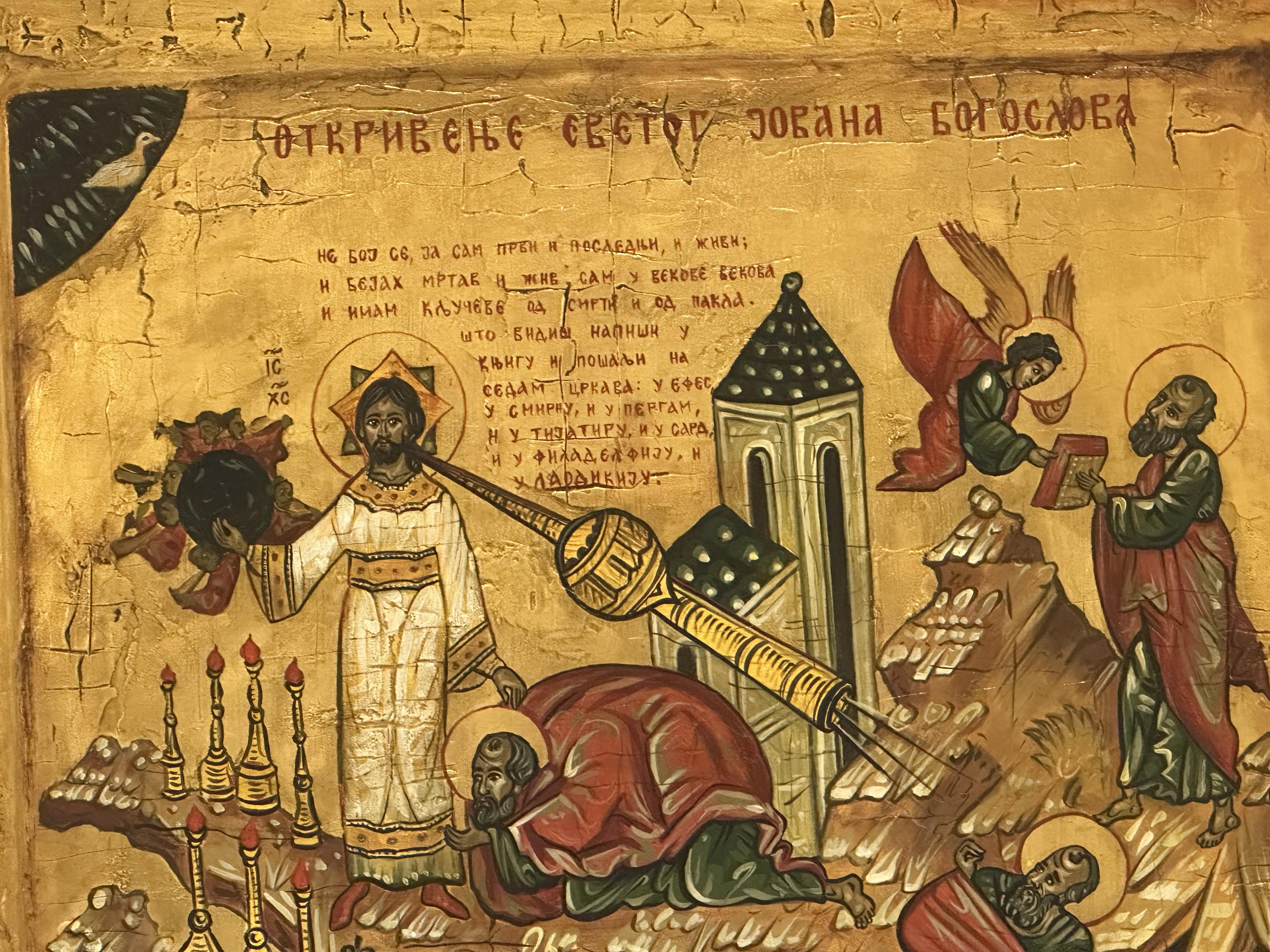
Image: Icon of the Revelation of Saint John the Theologian, replica by Miloš Ostojić from Šid
The work week from March 2 to March 6, 2026 left the impression that the world was once again on the edge of major geopolitical upheavals. News changed from hour to hour: escalation of conflict in the Middle East, dramatic reactions of financial markets, warnings from energy companies, and nervousness among investors around the world. In such an atmosphere, many began to wonder whether we are at the beginning of a new global crisis or simply witnessing another cycle of instability that the global system must absorb.
Historically speaking, the Middle East is a region where religion, geopolitics, energy resources, and major powers intersect. The conflict we are currently witnessing is not merely a regional one—it reflects much deeper power dynamics. Regional powers such as Iran, Israel, Saudi Arabia, and Turkey are directly involved or indirectly influential, while global actors such as the United States, Russia, and China also play significant roles. Every escalation in this region immediately affects oil prices, the security of transport routes, and the stability of financial markets.
That is why the work week at the beginning of March appeared almost apocalyptic. Investors reacted reflexively—capital was withdrawn from riskier sectors, interest in gold and safer forms of assets increased, while energy markets reacted nervously. In such moments the financial world becomes extremely sensitive because any indication of conflict expansion can trigger a domino effect.
However, history teaches us that conflicts in the Middle East rarely have short durations. They are often prolonged, with phases of escalation and de-escalation. For this reason, many analysts believe this is not an event that will end in a few weeks or months. Conflicts of this kind can last for years, even decades, with occasional diplomatic agreements bringing temporary stability.
The key question is not only when the conflict will end, but how it will end. There are three realistic scenarios. The first is limited regional stabilization through international pressure and diplomatic negotiations. The second is a prolonged frozen conflict in which tensions remain present but without a large open war. The third—and most dangerous—is the expansion of the conflict to a wider region, which would have serious consequences for the global economy.
Today the world is far more interconnected than it was several decades ago. Energy markets, financial systems, logistics, and international trade form a single interconnected system. Because of this, a local conflict is no longer just a local issue. It almost automatically becomes a global economic and political topic.
Despite the dramatic headlines and the sense of uncertainty that appeared during the first week of March, history shows that the global system has a remarkable capacity for adaptation. Major economies, international institutions, and capital markets have learned to function even under conditions of geopolitical shocks.
For this reason, although the work week from March 2 to March 6, 2026 resembled apocalyptic scenarios, it is more likely that we will witness another long period of geopolitical maneuvering rather than a complete collapse of the international order.
For investors, companies, and states, the most important lesson remains the same: in times of global instability, the key advantage becomes the ability to adapt quickly and manage risks effectively. Those who understand the broader picture and know how to manage risk often emerge from crises stronger than before.
And the Middle East, as it has many times throughout history, will remain a region where the major currents of world politics are shaped.
StandardPrva is here to help.
/ / /
"Standard Prva" LLC Bijeljina is a company registered in Bijeljina at the District Commercial Court in Bijeljina. Company’s activities are accountancy, repurchases of receivables, angel investing and other related services. Distressed debt is a part of the Group within which the company repurchases the receivables, which function and are not returned regularly.
Lawyer’s Office Stevanović is the leading lawyer’s office in the region with the seat in Bijeljina. The LO abbreviation represents Lawyer’s Office of Vesna Stevanović and Lawyer’s Office of Miloš Stevanović.
Contact for media press@advokati-stevanovic.com or via telephone 00 387 55 230 000 or 00387 55 22 4444.