StandardPrva Historical Analysis – The Anniversary of the Bretton Woods system: What Did It Bring to the World and Does It Have a Future?
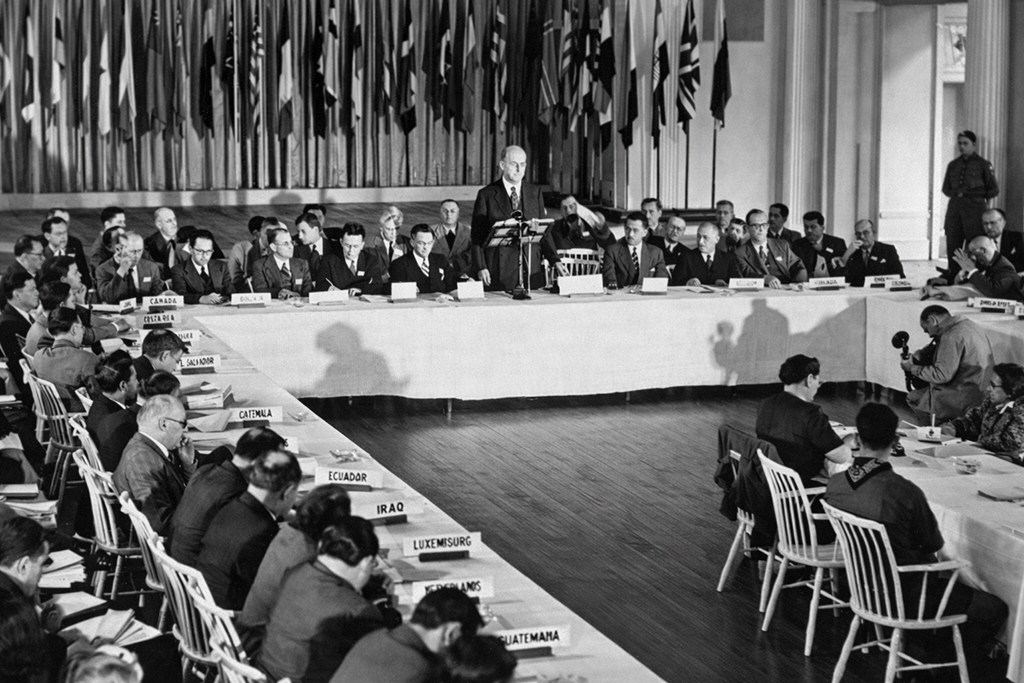
24.02.2026In July 1944, while the World War II was still ongoing, representatives of 44 countries gathered in the small town of Bretton Woods in the U.S. state of New Hampshire with an ambitious goal: to design a new economic order for a world that would soon emerge from the ruins of war. From that meeting emerged the Bretton Woods system — the foundation of the postwar financial architecture and one of the most significant economic agreements in modern history.
Its essence was simple yet revolutionary. Currencies were pegged to the U.S. dollar, and the dollar was convertible into gold at a fixed price. This established a system of stable exchange rates intended to prevent the chaos of competitive devaluations, trade wars, and financial collapses that had marked the 1930s. At the same time, two key institutions were created: the International Monetary Fund and the World Bank, tasked with overseeing system stability and supporting economic reconstruction and development.
The benefits of this order were multiple. Above all, it delivered stability. Predictable exchange rates and clear rules of the game enabled strong growth in international trade and investment. Western Europe and Japan experienced rapid recovery, and the global economy entered a period of expansion often referred to as the “golden age” of capitalism. Bretton Woods restored confidence in the international financial system and created a framework in which countries could cooperate rather than retreat into protectionism.
Another major gain was institutional. The International Monetary Fund became the guardian of monetary stability and a crisis lender to countries facing balance-of-payments difficulties. The World Bank focused on long-term development and infrastructure projects. Even after the formal end of the system, these institutions remained pillars of the global financial order.
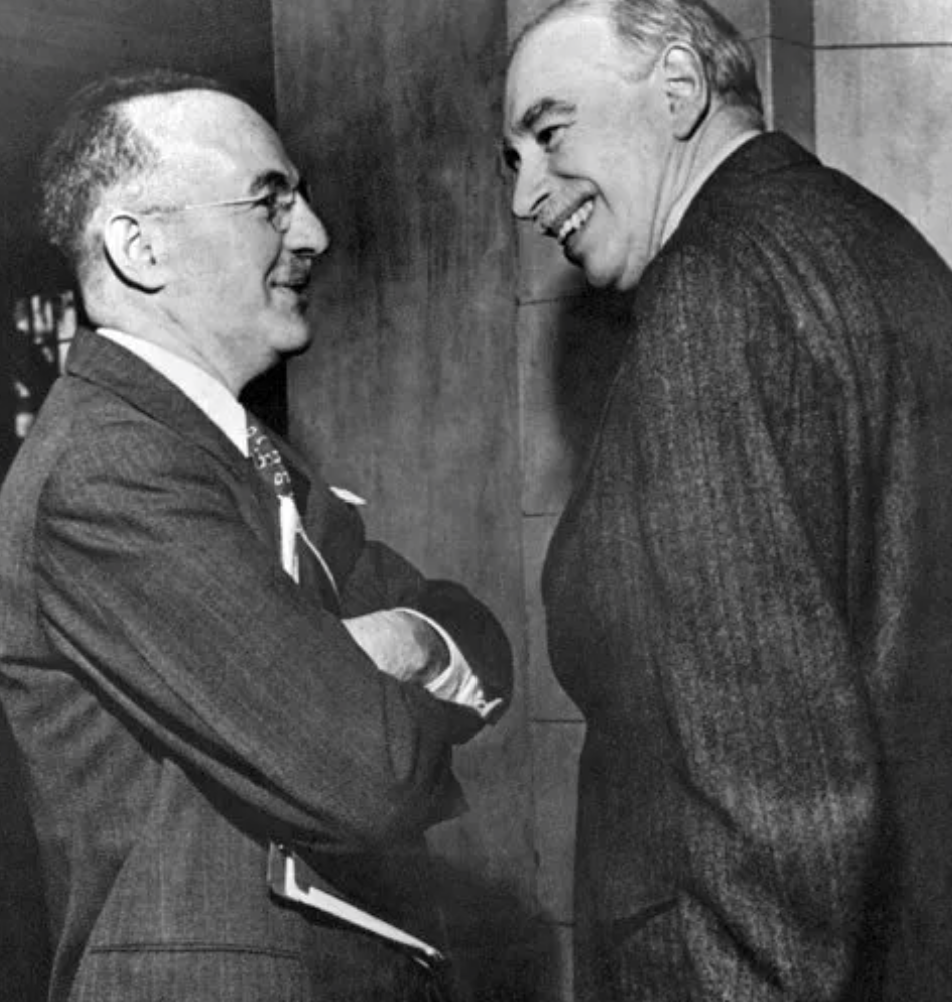
Hari Dexter White (left) and Lord John Maynard Keynes (right) at the Monetary Conference in Bretton Woods, 1944. Courtesy of the World Bank Group Archives.
However, the system could not last indefinitely. By the late 1960s, structural problems had begun to emerge. The United States, as issuer of the world’s reserve currency, faced growing deficits and inflation. Increasing amounts of dollars circulated globally, while confidence in their convertibility into gold began to erode. In 1971, the U.S. administration suspended the dollar’s convertibility into gold, effectively ending the fixed exchange rate system. The world transitioned to a regime of floating currencies that continues to this day.
Yet although the original mechanism disappeared, the spirit of Bretton Woods did not. Today’s international monetary system is no longer based on gold, but it still relies on coordination among central banks, the role of the dollar as the dominant reserve currency, and the work of international financial institutions. In times of crisis — from the Asian financial crisis to the global recession and contemporary geopolitical shocks — these institutions have continued to play a key stabilizing role.
The key question raised on this anniversary is how the system will function going forward. The world today is multipolar. Economic powers such as China, India, and other emerging markets are demanding greater influence in global decision-making. Debates are ongoing about reforming the International Monetary Fund, the role of new development banks, and the possible weakening of dollar dominance. At the same time, global finance faces new challenges such as digital currencies, climate change, and increasing market interdependence.
Perhaps the greatest lesson of Bretton Woods is that stability does not arise on its own. It is the result of political will, cooperation, and the readiness of states to accept common rules. That very idea — that international coordination is preferable to economic unilateralism — remains the most important legacy of the system.
The anniversary of Bretton Woods is therefore not merely a historical reminder. It is a call to reflect on how to structure the global economy in the 21st century. If 1944 was a moment of bold vision in a world full of uncertainty, our present time demands a similar ability to recognize shared interests and build a new framework of stability for the generations to come.
/ / /
"Standard Prva" LLC Bijeljina is a company registered in Bijeljina at the District Commercial Court in Bijeljina. Company’s activities are accountancy, repurchases of receivables, angel investing and other related services. Distressed debt is a part of the Group within which the company repurchases the receivables, which function and are not returned regularly.
Lawyer’s Office Stevanović is the leading lawyer’s office in the region with the seat in Bijeljina. The LO abbreviation represents Lawyer’s Office of Vesna Stevanović and Lawyer’s Office of Miloš Stevanović.
Contact for media press@advokati-stevanovic.com or via telephone 00 387 55 230 000 or 00387 55 22 4444.