A New Momentum in India–Russia Economic Relations: Putin’s Visit to New Delhi 2025
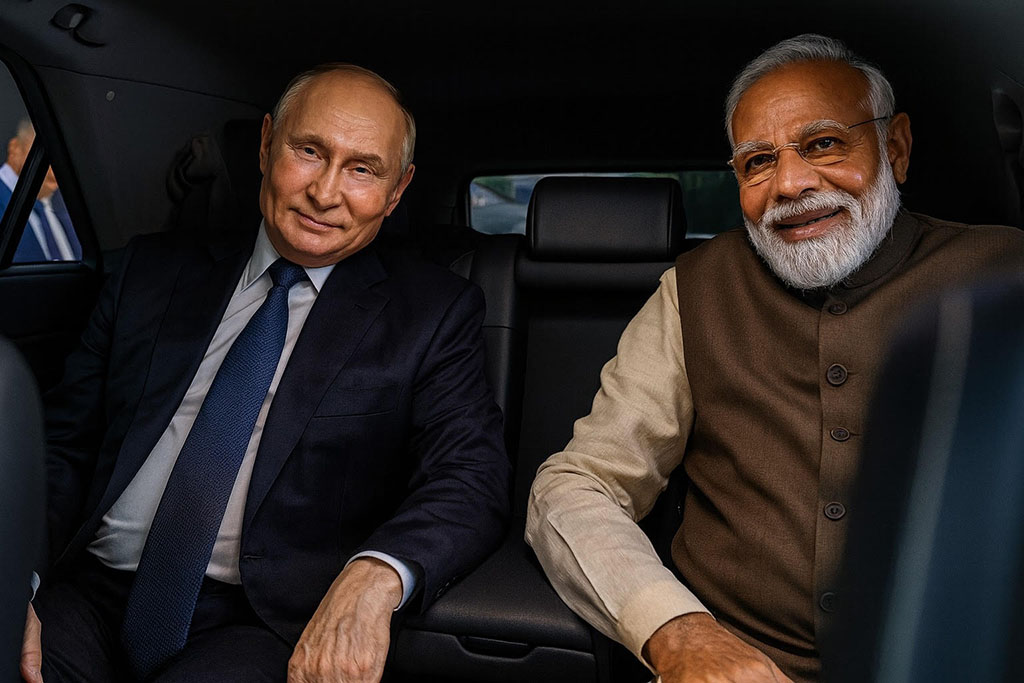
08.12.2025The meeting of Indian and Russian delegations in New Delhi during the official visit of President Vladimir Putin in December 2025.
The visit of Russian President Vladimir Putin to India on December 4–5, 2025 marked a new phase in the bilateral relations between the two countries. The 23rd annual India–Russia summit was held, which also marked 25 years of strategic partnership established with Putin’s first visit to New Delhi in 2000.
The leaders emphasized the special nature of their “Special and Privileged Strategic Partnership,” highlighting mutual trust and respect for national interests. India’s Prime Minister Narendra Modi described the friendship between the two states as “as steady as the North Star” in a changing world, built on mutual respect and trust. On the other hand, President Putin praised New Delhi for pursuing a sovereign policy and for its resilience to external pressures, noting India’s readiness to continue investing in the joint partnership.
Below are the key developments in economic cooperation achieved during this visit — from trade exchange, to the energy and military sectors, to strategic projects — supported by concrete data and statements from both sides.
Trade Exchange and Economic Cooperation
India–Russia trade has experienced dramatic growth in recent years. Overall bilateral trade increased from around USD 10 billion before 2022 to nearly USD 69 billion in 2025. This surge reflects a sharp rise in India’s imports of Russian oil at favorable prices, making Russia one of the largest suppliers of energy to India’s economy.
However, trade has remained unbalanced — Indian exports to Russia amount to only about USD 5 billion, compared to more than USD 64 billion in imports from Russia, leaving India with a deficit of roughly USD 64 billion. Both sides are aware of this imbalance and agreed to work jointly on reducing it, primarily by increasing Indian exports to the Russian market and diversifying the structure of trade.
During the meeting, the leaders adopted the Programme of Economic Cooperation until 2030 (“Programme 2030”), an ambitious plan that foresees further growth of trade and investment. The goal is to achieve annual trade of USD 100 billion by 2030, which practically means doubling current levels. Last year, bilateral exchange increased by about 12% and reached a record value, and this level is expected to be maintained throughout 2025.
To facilitate further growth, the two governments are intensifying negotiations on a free trade agreement between India and the Eurasian Economic Union (EAEU), which would remove remaining tariff barriers in sectors of mutual interest.
A significant milestone is the dedollarization of trade between India and Russia. Putin stated that 96% of mutual transactions are already conducted in national currencies — the Indian rupee and the Russian ruble — ensuring uninterrupted trade despite international sanctions. Mechanisms have been established for direct settlements in domestic currencies and for linking the payment systems of the two countries. This has significantly reduced dependence on the dollar and minimized risks of external financial restrictions.
Additionally, agreements were reached on strengthening logistical links and transport corridors to accelerate the movement of goods — including improvements to the International North–South Transport Corridor (INSTC) and the maritime route Chennai–Vladivostok.
To deepen economic cooperation, a series of memoranda of understanding were signed between the ministries of the two countries. These agreements cover areas such as agriculture, fertilizer production, the pharmaceutical sector, and information technology. For example, long-term supplies of Russian fertilizers to India were agreed, with the possibility of establishing joint ventures — crucial for the Indian agricultural sector.
The Russian side also expressed interest in importing Indian agricultural and fishery products, alongside resolving regulatory issues for market access. These measures are expected to help balance trade by opening greater access for Indian producers to the Russian market.
Prime Minister Modi stated that the newly agreed initiatives will raise “India–Russia economic partnership to new heights,” emphasizing the readiness of both countries to “turbo-charge” their economic ties in the coming years.
Energy Cooperation as the Pillar of Partnership
The energy sector occupies a central place in the renewed relationship between Moscow and New Delhi. Indian Prime Minister Modi said that energy security is one of the most important pillars of India–Russia partnership. This is confirmed in practice: Russia has become India’s largest single supplier of crude oil over the past two years.
In 2025, more than 30% of India’s oil imports came from Russia, thanks to favorable prices offered by Moscow after Western sanctions. During the summit, President Putin assured Indian partners that Russia would remain “a reliable supplier of energy resources” for India and that it is “ready to continue uninterrupted fuel supplies for the needs of India’s rapidly growing economy.”
This message — that oil and gas supplies from Russia will continue smoothly — resonated beyond bilateral relations, as it was also directed at Western countries pressuring New Delhi to reduce cooperation with Moscow.
India, however, made it clear that it will continue purchasing Russian energy to meet its development needs. In fact, Russia–India energy cooperation has remained largely “insensitive to current circumstances and temporary political pressures,” Putin noted.
He also pointed out that Western countries themselves, such as the United States, continue to purchase Russian nuclear fuel for their power plants, questioning double standards: “If America has the right to buy our fuel (uranium), why shouldn’t India have the same right?” said the Russian leader.
This stance further strengthened the perception that India and Russia are determined to make their energy relationship resilient against all external challenges.
Beyond oil and natural gas, cooperation is expanding to other energy forms. The joint statement praised the comprehensive energy dialogue between the two countries, which includes projects in oil refining, petrochemicals, liquefied natural gas (LNG), liquefied petroleum gas (LPG), and even innovative technologies such as underground coal gasification.
Civil nuclear energy represents a special segment — an area of cooperation lasting for decades. Russia and India confirmed the continuation of joint work on nuclear power plants, including the Kudankulam plant project in Tamil Nadu, where Russian companies are involved in the construction of several reactor units.
The two sides also plan to open a new site for a nuclear power plant in India, using Russian VVER reactor technology, as part of New Delhi’s efforts to increase nuclear capacity to 100 GW by 2047. This cooperation in the atomic sector will contribute to India’s energy diversification while creating opportunities for technology transfer and greater participation of Indian firms in the nuclear equipment supply chain.
Defense Industry and Military Cooperation
Traditionally, military-technical cooperation has been one of the pillars of the Moscow–New Delhi relationship. For decades, Russia has been the main supplier of India’s weapons — from tanks and aircraft to air-defense systems.
lthough in recent years the Indian government has diversified procurement sources (also purchasing equipment from Western countries), Russia remains India’s biggest single supplier of weaponry.
During Putin’s visit, the two sides agreed on a “reshaping” of defense relations in a way that corresponds to contemporary challenges. The focus is shifting from a buyer–seller relationship to deeper industrial cooperation: joint development and production of military equipment.
According to the official statement, the partnership is now oriented toward development, co-production, and technology transfer for advanced defense systems, in line with India’s “Make in India” initiative.
On December 4, New Delhi hosted a session of the Intergovernmental Commission on Military-Technical Cooperation (IRIGC-M&MTC), which defined concrete steps for strengthening industrial partnership.
Both sides expressed satisfaction with regular military contacts — including joint military exercises “INDRA” conducted regularly by the armed forces of the two countries. They agreed to maintain continuity of these exercises and exchanges of military delegations, contributing to operational coordination and mutual trust.
Particular emphasis was placed on producing spare parts and ammunition in India for existing Russian systems in India’s arsenal. The Russian side agreed — through technology transfer and joint ventures — to enable India to manufacture components for tanks, aircraft, and other Russian-built weapons, thus facilitating maintenance and reducing dependence on imported spare parts.
Interestingly, such joint production could also support exports to friendly third countries, opening the possibility for India to become a regional hub for overhaul and deliveries of Russian military technology.
During the summit, no new major weapon purchases (such as additional S-400 systems or fighter jets) were announced — at least not publicly — but both sides confirmed their commitment to long-term defense cooperation. Moscow and New Delhi agreed that there will be no backtracking in security cooperation despite external pressures, and that they will work together on modernizing India’s armed forces.
Russian officials stressed that India’s self-reliance in defense production remains a shared goal, with Russia offering full support to “India’s efforts to become self-sufficient in defense manufacturing.”
This position aligns with Moscow’s broader approach — to preserve its role as a key partner of the Indian military while adapting to India’s growing ambition to produce more weapons domestically.
Strategic Partnership and New Projects
At the political–strategic level, the meeting between Putin and Modi confirmed that relations between New Delhi and Moscow remain a priority and are resilient to global challenges. In their joint declaration, the two countries emphasized that despite a “complex and uncertain geopolitical situation,” they have managed to remain close partners, and that their relations are “resistant to external pressures” and represent a factor of stability on the global stage.
This message carries particular weight in the context of the war in Ukraine and Western efforts to isolate Russia. India, which has pursued an independent foreign policy since the Non-Aligned Movement, balances relations with major powers — and has made clear that it does not intend to sacrifice its historical friendship with Moscow despite Western disapproval. Modi reiterated India’s principles regarding the Ukraine crisis, stating that “India stands on the side of peace” and that “this is not an era of war,” but did not directly call for condemnation of Russia.
Thus, New Delhi has maintained a cautious posture, focusing on the bilateral agenda.
The summit also produced several strategic initiatives aimed at shaping the future of relations.
A key area highlighted was the strengthening of connectivity and infrastructure between the two countries. The leaders agreed to accelerate work on major transportation corridors — primarily the full operationalization of the land–sea route from Russia to India through Iran (INSTC), and the direct maritime line between Vladivostok and Chennai.
In parallel, India is increasingly investing in Russia’s Far East: a five-year cooperation program for the development of the Russian Far East (2024–2029) was adopted, envisioning Indian investments in agriculture, mining, energy, diamonds, and transport in this resource-rich but sparsely populated region.
Indian companies, with government support, are expected to participate in projects involving the extraction of Russian critical minerals and raw materials necessary for high-tech industries.
Cooperation also extends to the Arctic — Russia welcomed the participation of Indian experts at the international Arctic forum in Murmansk, and supported India’s status as an observer in the Arctic Council. New Delhi sees an opportunity to access resources and routes in the polar region through Russian partnership, including the Northern Sea Route as a potentially important commercial corridor in the future.
High technologies and strategic industries are also expanding areas of cooperation. India’s space agency ISRO and Russia’s Roscosmos are strengthening cooperation in space exploration, including plans for joint projects in manned missions, satellite navigation, and planetary research. Work is already underway on transferring Russian expertise in rocket engines, which could benefit India’s future space missions.
In the domain of digital technologies and innovation, channels have been opened for connecting startups and research teams from the two countries — with agreements to promote joint projects in artificial intelligence, cyber security, and other advanced technologies.
This cooperation carries dual significance: economic (development of new industries) and strategic (reducing dependence on Western technologies).
It is important to note that the India–Russia partnership is not only bilateral but also multilateral. On the international stage, Moscow and New Delhi act in alignment in many forums.
Russia reiterated its “firm support” for India’s bid for a permanent seat on the UN Security Council, which India sees as a reflection of long-standing close cooperation.
Both countries cooperate closely within BRICS and the Shanghai Cooperation Organization (SCO), confirming their commitment to a multipolar world order and a stronger role for developing countries.
In fact, immediately after the New Delhi summit, India assumed the BRICS presidency for 2026 with full support from Russia.
During India’s G20 presidency in 2023, Moscow and New Delhi jointly promoted the voice of the Global South in global economic matters.
This synergy on the global stage further strengthens their strategic partnership.
Putin’s December 2025 visit to India clearly demonstrated that relations between Moscow and New Delhi have entered a new dynamic, characterized by intensified economic cooperation and strategic understanding.
In a global atmosphere of geopolitical upheaval, the two countries sent a message that their friendship remains steady and adaptable.
Concrete agreements on trade, energy, military industry, and infrastructure projects testify to their intention to modernize and deepen the partnership for mutual benefit.
At the same time, warm gestures — such as Prime Minister Modi personally welcoming Putin at the airport and traveling with him to dinner — symbolize a closeness that goes beyond protocol.
India and Russia have confirmed through this summit that they plan long-term cooperation, diversified and resilient to challenges, preserving a decades-long relationship that has, as stated, “always withstood the test of time.”
/ / /
"Standard Prva" LLC Bijeljina is a company registered in Bijeljina at the District Commercial Court in Bijeljina. Company’s activities are accountancy, repurchases of receivables, angel investing and other related services. Distressed debt is a part of the Group within which the company repurchases the receivables, which function and are not returned regularly.
Lawyer’s Office Stevanović is the leading lawyer’s office in the region with the seat in Bijeljina. The LO abbreviation represents Lawyer’s Office of Vesna Stevanović and Lawyer’s Office of Miloš Stevanović.
Contact for media press@advokati-stevanovic.com or via telephone 00 387 55 230 000 or 00387 55 22 4444.