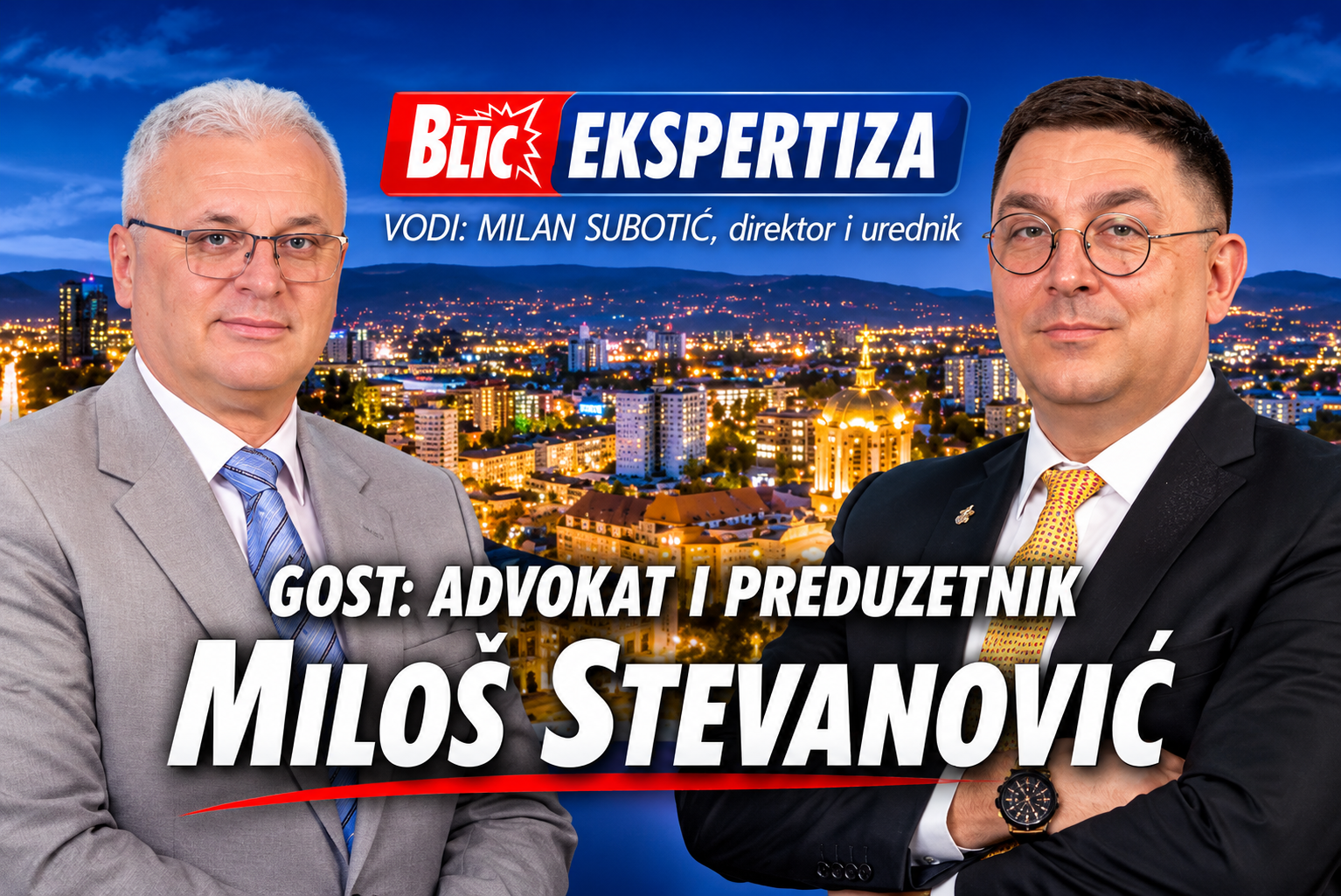
BLIC EXPERTISE: Miloš Stevanović – Bureaucracy Will Destroy Us Before an Atomic Bomb Does, and the State Has Turned into a System of “Acting Officials”
14.11.2026By Danka Zakić, journalist and Editor-in-Chief of Standard Classic Radio
In the first episode of the new programme “Blic Expertise”, broadcast on the Srpskainfo YouTube channel, Milan Subotić, Director of Euroblic and Editor-in-Chief of the Srpskainfo portal, welcomed Bijeljina-based lawyer and entrepreneur Miloš Stevanović. In an open, dynamic and, at times, particularly sharp discussion, the two interlocutors addressed the economic situation in Republika Srpska, tax policy, the business environment, public administration, corruption, education, investment, and society’s responsibility towards its most vulnerable members.
The discussion raised numerous issues that have burdened the economy and society of Republika Srpska for years. Although the speakers expressed differing views on certain economic solutions, they largely agreed on the need for fundamental public-sector reforms, more efficient institutions and an environment in which work, knowledge and entrepreneurship take precedence over bureaucracy and political favouritism.
The IRB Claims Acquisition: A Business Risk of Almost 40 Million Convertible Marks
One of the first topics discussed was the acquisition of claims from the Investment and Development Bank of Republika Srpska (IRB), a business venture that once brought Miloš Stevanović into the public spotlight. Asked directly by Milan Subotić how he had managed to make a substantial profit from the deal, Stevanović said that he considered the tax revenue paid into the Republika Srpska budget to be his greatest achievement, rather than the profit itself.
According to his calculations, the tax paid was sufficient to finance the operations of four large rural schools for an entire year. He presented this as an example of the private sector making a tangible contribution to the community. He explained that carrying out the transaction required taking on an exceptionally high financial risk and securing nearly 40 million convertible marks in borrowed funds, with no guarantee that the claims would ultimately be collected.
Discussing the business rationale behind the investment, Stevanović emphasised that his advantages lay in his knowledge of legal debt-recovery mechanisms, the organisation of a professional team and the ability to resolve complex creditor-debtor relationships through appropriate legal proceedings. As one example, he mentioned the company “Alumina”, which settled its obligations after the claims were acquired.
Republika Srpska as a Tax Haven: An Advantage for Investors or an Opportunity for Abuse?
An especially interesting debate focused on the tax policy of Republika Srpska, which Stevanović described as one of its greatest competitive advantages. With a corporate income tax rate of 10 per cent and no separate dividend tax, Republika Srpska, in his view, offers an exceptionally favourable tax framework that should be used more effectively to attract domestic and foreign investment.
Milan Subotić, however, raised the other side of the issue, pointing to the problems of the shadow economy, undeclared wage payments and the withdrawal of cash from companies. According to estimates he presented during the programme, a significant portion of the money withdrawn from businesses ends up in informal channels, including the payment of part of employees’ wages in cash, thereby reducing revenue for the pension and healthcare systems.
Subotić warned that such practices create serious unfair competition for businesses that properly fulfil all their tax and contribution obligations, while the state simultaneously loses substantial public revenue.
Stevanović, on the other hand, defended the existing approach to corporate profit and dividend taxation, arguing that illegal payments cannot be addressed by imposing additional taxes on all business owners. He stressed that undeclared wage payments are already unlawful and that the solution lies in more effective supervision, strengthening the capacities of the Republika Srpska Tax Administration and consistently enforcing existing laws.
In his view, the tax system should encourage capital formation, new investment and employment, while abuses should be dealt with by the competent supervisory and investigative authorities.
A State of Acting Officials: Temporary Appointments That Last for Years
One issue on which the two speakers were almost entirely in agreement was the long-standing practice of appointing acting officials to senior positions in public institutions and companies.
Stevanović expressed particular dissatisfaction with the fact that some officials in Republika Srpska and Serbia have held their positions as acting directors for years, sometimes even more than a decade, despite the fact that such appointments are, by their very nature, supposed to be temporary.
He argued that this practice undermines institutional accountability, legal certainty and professionalism in public administration, as temporary appointments become a permanent model of institutional management. As a radical reform proposal, he suggested legally limiting acting appointments to just eight days, after which the competent authorities would be required to carry out the regular appointment procedure.
Subotić further illustrated the phenomenon with an ironic suggestion that the abbreviation “v.d.” (acting official) should be replaced with “i.n.”, meaning “executor of orders”, alluding to the political dependence of certain public-institution managers.
Both speakers emphasised the need to restore the principles of legality, expertise, accountability and institutional independence in public administration.
Bureaucracy Will Destroy Us Before an Atomic Bomb Does
Speaking about the reforms that should be implemented in Republika Srpska, Stevanović identified the fundamental reduction of bureaucracy in society and the economy as one of the most important priorities.
In his opinion, excessive administration, complicated procedures, inefficient institutions and numerous regulatory restrictions have become some of the biggest obstacles to economic development.
Stevanović stressed that reducing the public sector does not necessarily mean mass layoffs. Instead, it should involve establishing an organised system for retraining employees and redirecting their professional skills towards sectors where there is a genuine demand for workers.
As a possible solution, he suggested reviving the concept of former workers’ universities, through which administrative employees could acquire new knowledge and skills, particularly in information technology, digital services and private entrepreneurship.
He emphasised that a modern state must not be an obstacle to citizens and businesses, but rather a service that enables them to exercise their rights quickly, simply and with legal certainty.
Government Borrowing Must Create New Value
A significant part of the discussion focused on public debt, budget policy and the way Republika Srpska borrows on domestic and international financial markets.
Subotić criticised the practice of borrowing to finance current expenditure and cover budget shortfalls, particularly when funds are obtained at relatively high interest rates.
Stevanović argued that public borrowing can be justified when it is directed towards projects that generate new economic value in the long term and enable future revenue growth.
Examples of such investments included energy infrastructure, motorways, technology centres and the development of data centres designed for artificial intelligence.
He stressed that economic policy must be based on investments that increase productivity, create new jobs and establish a long-term foundation for growth, rather than continuously financing existing administrative expenditure.
Why Don't We Have Major International Hotel and Retail Brands?
The programme also addressed the question of why Republika Srpska, despite its favourable geographical position, natural resources and relatively low tax rates, has failed to attract more well-known international companies.
Subotić pointed to the absence of major top-tier hotel chains, mentioning unsuccessful talks about the arrival of the “Hyatt” brand, as well as the fact that major international retail chains such as “IKEA” are not present in the Republika Srpska market.
Stevanović assessed that the main problem is not a lack of business opportunities, but rather complicated administrative procedures, legal uncertainty and the attitude of certain institutions towards investors.
He was particularly critical of the abuse of inspection powers and practices he described as extortion by inspectors, stressing that investors expect a predictable business environment, efficient administration and equal enforcement of regulations.
The speakers also discussed the banking sector, pointing to excessive procedures that make it difficult for citizens, young families and entrepreneurs to access loans, including housing and investment financing.
Purchased Degrees and the Erosion of Social Values
One of the sharper topics concerned forged and unlawfully obtained academic qualifications, as well as the consequences such practices have for public institutions, the judiciary and overall public trust in the system.
Subotić, with a touch of irony, suggested that given how widespread the problem had become, the state might even consider introducing VAT and excise duties on purchased degrees.
Stevanović warned about the serious consequences that unlawfully obtained qualifications can have in institutions of public importance, raising the question of how many employees would remain in their positions if all diplomas underwent a thorough verification process.
Both speakers stressed that it is impossible to build an efficient state or ensure long-term economic development without expertise, education and accountability.
The Treatment of Children with Developmental Disabilities Shows What Kind of Society We Are
A particularly emotional and socially significant part of the programme was devoted to the position of children with developmental disabilities, people with disabilities and families who face numerous institutional obstacles every day.
Stevanović criticised certain legislative solutions and the practices of the Republika Srpska Child Protection Fund, particularly in cases where parents of children with autism lose their entitlement to certain financial benefits once their children begin attending school with the support of an assistant.
He stated that Stevanović Law Office provides free legal assistance to associations and families facing such problems, including representation in court proceedings aimed at protecting their rights.
Speaking about society’s attitude towards people with disabilities, Stevanović warned that pushing them to the margins of society is unacceptable and that a culture of acceptance, equality and solidarity must be developed.
He also recalled the humanitarian work of the family foundation “Branislav and Vesna Stevanović”, which supports children without parental care, children with developmental disabilities and socially disadvantaged families, including members of the Roma community in Bijeljina.
Subotić spoke about Srpskainfo’s editorial team's experience working with children with Down syndrome and their associations, calling on the relevant institutions to provide more stable financial and institutional support to organisations that work with the most vulnerable groups of the population on a daily basis.
Both speakers emphasised that the true development of a society is measured not only by economic indicators, but also by how it treats those who need help the most.
Standard Classic: Classical Music as an Alternative to Modern Superficiality
Towards the end of the discussion, economic, political and social issues gave way to culture, education and classical music.
Stevanović, who is also a pianist by education, presented the “Standard Classic” project, a non-commercial online radio station dedicated to classical music, inspired by the well-known British station Classic FM.
He explained that the project's aim is to bring classical music closer to a wider audience, particularly young people, who need access to quality cultural and educational content in today's digital environment.
He emphasised that the project was not launched with commercial ambitions, but out of a desire to promote art, education and values that transcend the everyday superficiality of social media.
Subotić welcomed the initiative and recalled the previous experience of Ringier Axel Springer with distributing classical music releases, which, despite initially sceptical expectations, attracted exceptional public interest and required additional print runs. The radio station can be accessed via www.standardclassic.ba.
An Open Discussion About the Future of Republika Srpska
The first episode of “Blic Expertise” demonstrated the importance of open discussions between media representatives and the business community in understanding economic and social challenges.
Milan Subotić and Miloš Stevanović did not agree on every issue, particularly regarding tax policy and certain economic solutions. Nevertheless, through an argument-based discussion, they raised a number of topics that deserve considerably greater attention from the public and institutions.
From the need to reform public administration and manage public funds more responsibly, through creating a more favourable investment environment, to protecting the most vulnerable members of society, the discussion highlighted the need for changes that would enable Republika Srpska to achieve more stable and sustainable long-term development.
The programme ended on a friendly note, with both speakers inviting each other to future appearances. Stevanović accepted an invitation to appear again in the landmark 100th episode of “Expertise”, while inviting Milan Subotić to be a guest on his business podcast.
You can watch the full episode of “Blic Expertise”, featuring Miloš Stevanović, on the Srpskainfo YouTube channel, at the link below.
/ / /
"Standard Prva" LLC Bijeljina is a company registered in Bijeljina at the District Commercial Court in Bijeljina. Company’s activities are accountancy, repurchases of receivables, angel investing and other related services. Distressed debt is a part of the Group within which the company repurchases the receivables, which function and are not returned regularly.
Lawyer’s Office Stevanović is the leading lawyer’s office in the region with the seat in Bijeljina. The LO abbreviation represents Lawyer’s Office of Vesna Stevanović and Lawyer’s Office of Miloš Stevanović.
Contact for media press@advokati-stevanovic.com or via telephone 00 387 55 230 000 or 00387 55 22 4444.