The Arctic Is Becoming a New Trade Route: War, Climate and Geopolitics Are Reshaping Global Transport
15.10.2026As traditional shipping routes face wars, political risks and disruptions, the melting Arctic ice is opening up an alternative that, until just a few years ago, was almost unimaginable for regular international transport.
Global trade is slowly changing its geography. For decades, the maritime routes carrying energy, raw materials and goods between Asia and Europe could be viewed primarily through the lens of distance and transport costs. Today, however, shipping safety, wars, political relations and climate change are increasingly determining which routes goods will take to reach European markets.
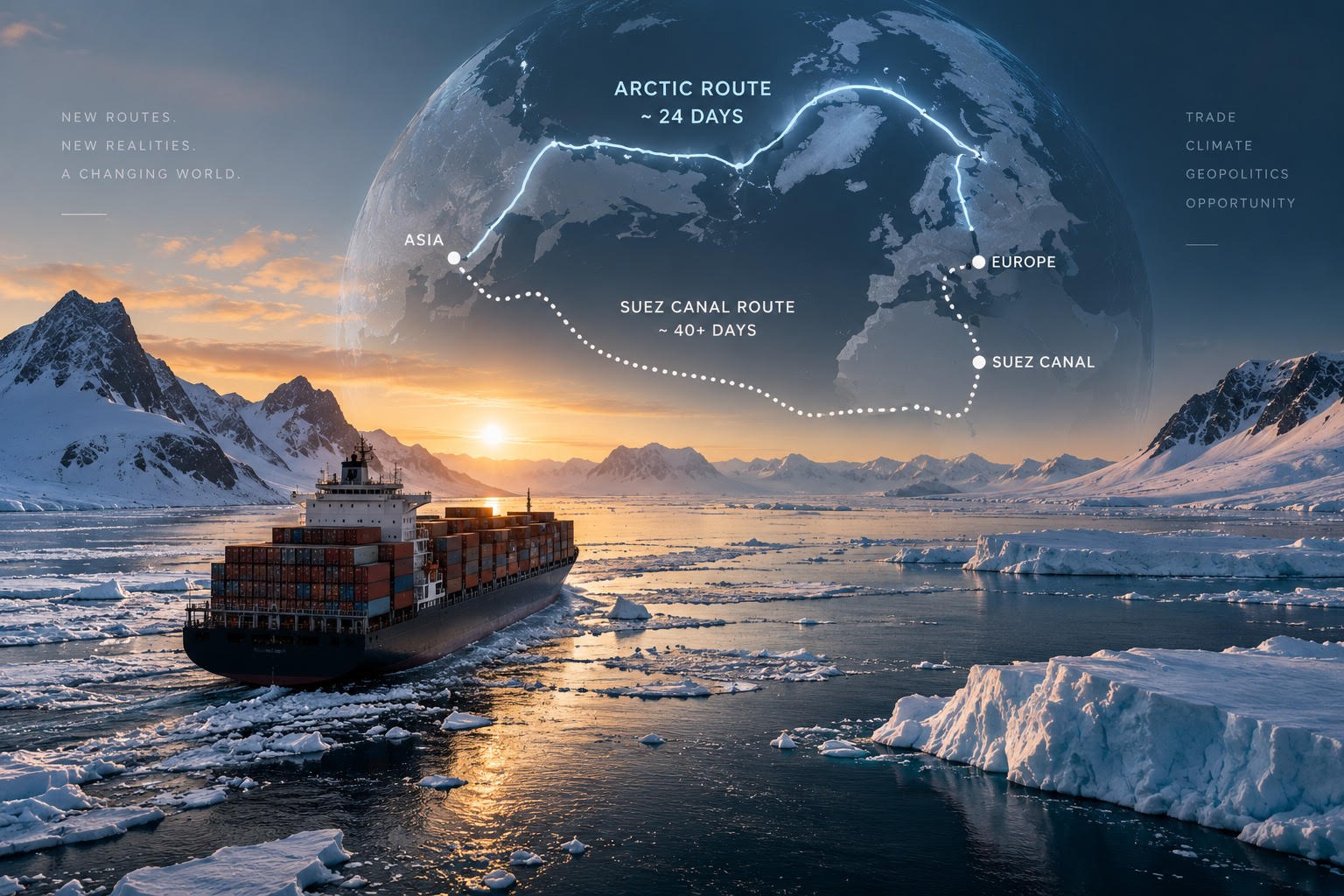
The Financial Times, in an article titled “Arctic sea routes boom as Gulf war and global warming lead to ship diversions,” reports that the number of voyages through the northern sea routes has increased fourfold over the past four years. According to data from Lloyd’s List Intelligence cited by the FT, 133 voyages were recorded in September this year, representing a 46 percent increase compared with August.
What is particularly interesting is that almost half of these transits were made by Russian-flagged vessels, while Chinese shipping companies are increasingly using the Arctic route to reach the European market, bypassing traditional routes through the Middle East.
From China to Europe via the Arctic
One example cited by the FT illustrates just how significant this change could become. The Chinese vessel Dubai Tower departed from Qingdao for the British port of Felixstowe via the Arctic, rather than through the Suez Canal.
The estimated journey time was 24 days.
This is not merely an interesting shipping statistic. If such routes become sufficiently reliable and commercially viable, part of the transport between Asia and northern Europe could acquire an entirely new economic logic. A shorter route can mean fewer days at sea, a different cost structure, less working capital tied up in goods in transit, and potentially faster supply chains.
However, the Arctic is not yet a replacement for the Suez Canal. Its accessibility depends on the season, ice conditions, infrastructure, insurance, regulatory arrangements and geopolitical relations.
Wars Are Redrawing the World’s Trade Map
The reason for the growing interest in northern routes is not simply melting ice. The security of traditional maritime corridors is an equally important factor.
The Red Sea and the Bab el-Mandeb strait have demonstrated in recent years how a relatively narrow geographical passage can affect a huge share of global trade. When risks at such a chokepoint increase, shipping companies must choose between higher insurance costs, longer routes or completely alternative corridors.
That is precisely why the Arctic is gaining strategic value.
According to data cited by the FT, the number of bulk carriers using this route increased from 12 in September last year to 29 in September this year. At the same time, a record number of crude oil tankers was also recorded.
This shows that the Northern Sea Route is no longer merely an experimental route for a handful of specialized vessels.
Russia and China Have a Particular Interest
The Arctic route also has a strong geopolitical dimension.
Russia has long been developing infrastructure and energy projects in its Arctic territories. Liquefied natural gas carriers use the northern route to serve the Yamal LNG and Arctic LNG 2 projects, while the route is increasingly being used to transport other raw materials as well.
For China, the potential is different but equally significant: an alternative means of accessing the European market that reduces dependence on certain traditional maritime chokepoints.
If this trend continues, the Arctic will not be merely a matter of maritime transport. It will become part of a broader story involving energy security, trade relations between Russia, China and Europe, and control over the infrastructure through which global goods move.
But There Is a Significant Cost
The paradox is obvious: global warming is enabling more intensive shipping in the Arctic, while increased shipping may place additional pressure on precisely this exceptionally fragile ecosystem.
The FT cites warnings from insurers and environmental organizations that rising traffic could increase the risk of a serious accident in an area where rescue operations and environmental response are far more difficult than on traditional routes.
A particular concern is so-called black carbon, produced by the combustion of marine fuels. When these dark particles settle on snow and ice, the surface absorbs more solar energy, potentially accelerating melting.
A major oil spill in the Arctic would pose an especially severe environmental and logistical challenge.
Why Does This Matter to Our Companies?
At first glance, it may seem that Arctic shipping routes have little to do with the operations of a company in Bosnia and Herzegovina. In reality, the modern economy works in precisely the opposite way.
The cost of transporting goods from China affects the price of equipment we import. Energy prices affect production. Transport times affect inventories and working capital. A war near a single maritime chokepoint can increase costs for European industry thousands of kilometres away.
That is why serious business planning today can no longer be based solely on the income statement and conditions in the domestic market. Companies need to understand geopolitics, logistics, energy, interest rates and changes in global supply chains.
The Arctic is an excellent example of how quickly something that represented a geographical obstacle for decades can become an economic opportunity — but also a new source of risk.
A New Map of the Global Economy Is Already Being Drawn
The Suez Canal will not disappear, nor will the Arctic suddenly become the main commercial highway between China and Europe. But that is not the point of this story.
What matters is that companies are now actively looking for multiple possible routes for the same goods.
The globalization of the future may therefore not simply mean finding the cheapest supplier and the shortest route. Increasingly, it will mean finding the most resilient route — one that can continue to function despite war, political crises, climate change and market disruptions.
When a ship travelling from China to the United Kingdom begins considering a route through the Arctic instead of the Suez Canal, it is more than a change in navigation.
It is a sign that the map of the global economy is changing before our eyes.
/ / /
"Standard Prva" LLC Bijeljina is a company registered in Bijeljina at the District Commercial Court in Bijeljina. Company’s activities are accountancy, repurchases of receivables, angel investing and other related services. Distressed debt is a part of the Group within which the company repurchases the receivables, which function and are not returned regularly.
Lawyer’s Office Stevanović is the leading lawyer’s office in the region with the seat in Bijeljina. The LO abbreviation represents Lawyer’s Office of Vesna Stevanović and Lawyer’s Office of Miloš Stevanović.
Contact for media press@advokati-stevanovic.com or via telephone 00 387 55 230 000 or 00387 55 22 4444.