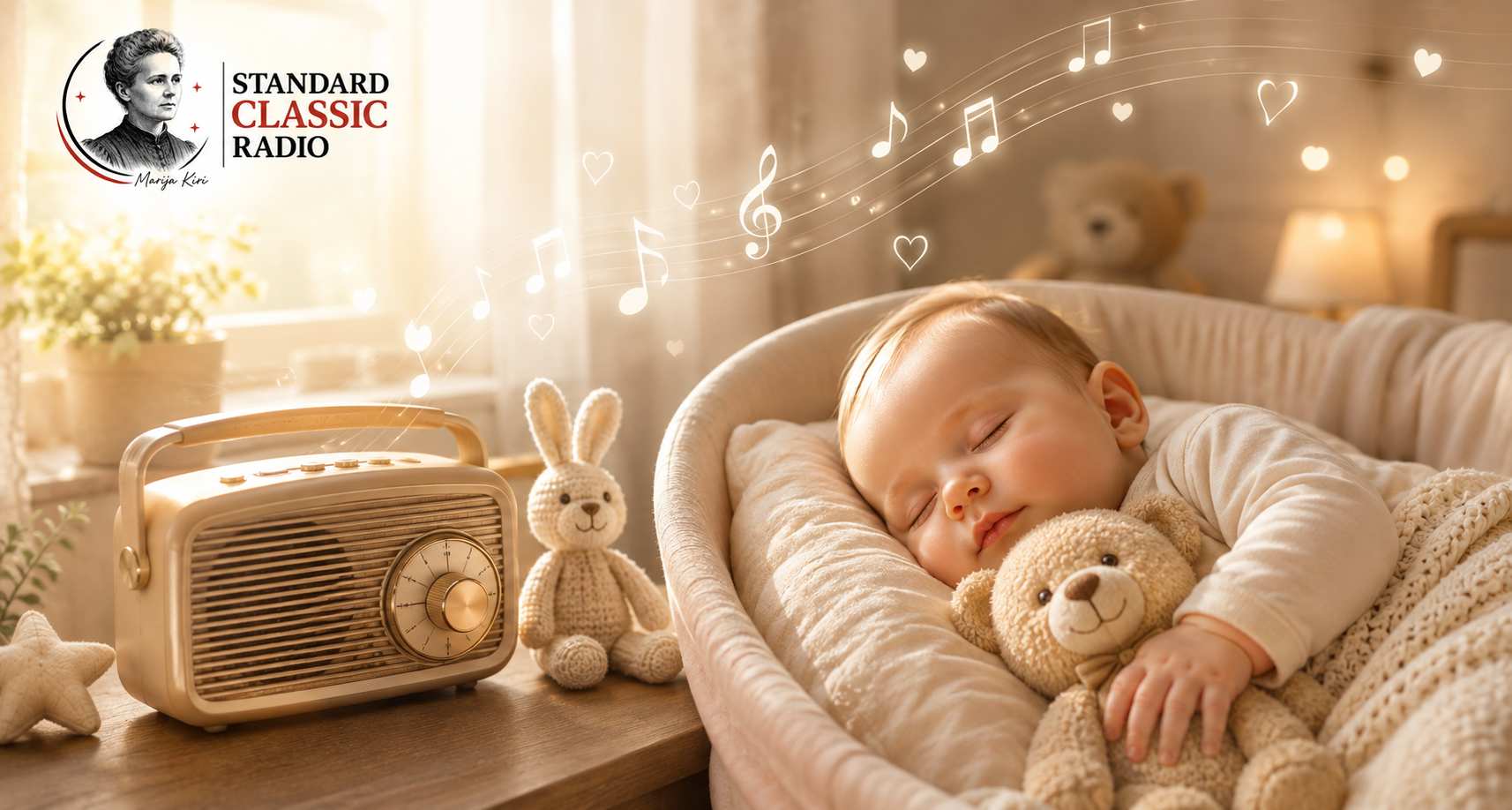
More and More Parents Are Letting Their Babies Listen to Standard Classic Radio: Music That Soothes from the First Days of Life
13.08.2026Recently, Standard Classic Radio has been receiving a particularly beautiful kind of message. Parents, especially mothers, have been telling us that they are no longer the only ones listening to our programme. Standard Classic has become part of the daily routine of their babies and young children. Some of the messages are almost identical: “When we turn on Standard Classic, the baby calms down.” Other mothers tell us that they leave the radio on while putting their child to sleep, during feeding, or while the baby is resting. Some tell us that their child stops being restless when they hear the music, others that they fall asleep more easily, while some simply lie quietly and listen. For us, this may well be the most beautiful compliment a radio station can receive.
Standard Classic was not created as a radio station for babies. It was born from a desire to bring beautiful music, culture, tranquillity and a different rhythm of life back into our everyday lives. But it seems that our youngest listeners were among the first to recognise exactly what we wanted to create — a space without noise, aggression and the constant struggle for attention.
Why Do Babies Calm Down with Music?
What parents describe to us is not merely a charming coincidence. The relationship between music and babies begins long before a child can speak, and even before birth. Rhythm, melody, repetition and the timbre of the human voice are among the first complex sound patterns a child encounters.
Research into lullabies is particularly interesting. In one experimental study involving 144 babies between two and fourteen months of age, children listened to lullabies from cultures completely unfamiliar to them and in languages they did not know. Even so, physiological signs of relaxation were recorded during the lullabies, including a slowing of the heart rate and changes in other indicators of arousal. In other words, a baby does not have to “know” a particular song in the way an adult knows it in order to respond to its characteristics.
Researchers believe that important factors include musical characteristics traditionally associated with lullabies: a slower tempo, a gentler melodic flow, fewer sudden changes and a more predictable structure. Such sound patterns may be associated with a reduction in a baby’s level of arousal.
It is also interesting that babies distinguish very early between singing directed at them and other types of sound. Scientific literature shows that infant-directed singing attracts their attention, can influence their level of arousal and reduce distress. Music and singing during the earliest period of life are also associated with communication between parents and children.
It Is Not Just About Getting the Baby to Sleep
When we say that music “calms” a child, this does not necessarily mean that the child will immediately fall asleep. Calmness and sleep are not the same thing. Sometimes the effect is simply that the child becomes less distressed; sometimes they listen more attentively, while at other times their body gradually relaxes. When this atmosphere is combined with a familiar environment, the presence of a parent, dim lighting and an established evening routine, music can become one of the signals that it is time to rest.
Routine is particularly important in early childhood. Modern reviews of research into interventions for children’s sleep frequently emphasise consistent bedtime routines, sleep hygiene and creating conditions in which a child gradually associates certain patterns with rest. This helps us understand the experience of parents who tell us: “As soon as we turn on the radio, she knows it is bedtime.” Over time, music can become part of a familiar environment — not a magical way of putting a child to sleep, but one element of a ritual: a bath, dimmed lights, a parent’s embrace, familiar voices and quiet music in the background.
Why Is Classical Music Particularly Suited to Such an Atmosphere?
It is important to be precise here. Science does not say that every piece of music classified as “classical music” automatically puts every baby to sleep. Classical music can be extremely gentle, but it can also be dramatic, loud, fast and full of sudden dynamic changes. Therefore, it is probably not the label classical music that matters most, but the characteristics of the particular musical content.
Calmer compositions often have precisely the qualities that suit an atmosphere of rest: a slower tempo, gradual changes, repetition of motifs, harmonic predictability and an absence of aggressive sonic elements. This is one reason why the programme of Standard Classic Radio can naturally fit into a family home. The radio does not have to constantly demand attention. It can simply exist in the background — and perhaps that is exactly what has become so unusually valuable today.
In a World Full of Noise, We Offer Children Peace
Modern life surrounds us with screens, notifications, short videos, advertisements and sounds competing with one another for a few seconds of our attention. Children are growing up in the same world. That is why we particularly like the thought that somewhere, perhaps right now, Standard Classic is playing quietly in a child’s room. A parent is going about their daily activities while the baby sleeps or calmly listens to music — without screens, without an image changing every two seconds and without the need to watch anything. Just music.
There is another important dimension to this story. The music parents play for their children often becomes part of a shared family experience. A baby may not remember a particular composition in the way an adult does, but sound, repetition, the presence of a parent and a feeling of security create a shared whole. Research into infant-directed singing points precisely to a strong connection between music, attention, emotional regulation and social communication during the earliest period of life.
Music Also Has an Effect on Parents
There is something else that should not be overlooked. When we play calm music for a baby, the parent in the same room is usually listening to it as well. If the mother or father relaxes, lowers their voice, slows their movements and spends a few quieter minutes with the child, the entire atmosphere of the room changes. The baby does not respond only to the speaker. They respond to their whole environment, especially to the person caring for them.
That is why it may be misleading to view music merely as a sound stimulus that “acts on the baby”. It is much more beautiful, and probably closer to reality, to see it as part of the relationship between parent and child. Music calms the room, the parent becomes more relaxed, and the child senses the change in atmosphere and gradually accepts that it is time for peace and quiet.
Research Gives Us Reason for Optimism — but Without Exaggeration
There are also studies of music involving premature babies in hospital settings. Systematic reviews and individual clinical studies have found promising results in terms of comfort, physiological parameters and sleep, although studies differ in methodology and it would not be justified to conclude from them that music is a universal therapy.
This is important for us to emphasise because Standard Classic Radio is not a medical treatment, nor do we want to promise parents that music will solve sleep or distress problems for every child. Every baby is different, and more serious or persistent problems with sleep, feeding or unusual irritability should be discussed with a paediatrician. Nevertheless, there are sufficient scientific reasons to take seriously what parents spontaneously tell us: gentle, appropriately selected music really can be part of an environment that helps a baby calm down.
The Youngest Audience of Standard Classic Radio
When we created Standard Classic, we were thinking about people who wanted to listen to quality music again. People who work, read, drive, rest or simply want their home to have a different soundscape. We could not have imagined that we would start receiving messages about listeners who do not yet even know how to speak — and yet those messages are now among the ones we remember most.
Somewhere, our programme accompanies the final evening feeding. Somewhere, a mother is holding her baby in her arms. Somewhere, the child is already asleep and the radio has been left quietly playing in the background. And somewhere, a slightly older child is hearing the sound of a piano, violin or full orchestra for the first time, completely unaware of it. Perhaps one day they will love classical music; perhaps they will not. But that is not the most important thing right now. What matters is that they encounter music from the very beginning of life as something pleasant, as something that belongs in the home and as something associated with security, a parent’s embrace and peace.
Thank You to the Parents Who Tell Us About This
We would therefore like to thank all the mothers and fathers who have written to us and told us that they listen to Standard Classic together with their children. Please continue sending us your stories. Tell us what your babies like to listen to, whether you have your own evening ritual, which music helps them calm down most easily and which compositions have, quite unexpectedly, become part of your children’s growing up. Such messages help us think even more carefully about the programme we create.
Perhaps the greatest value of radio is precisely that it does not always have to be at the centre of attention. Sometimes it is enough simply to be there, quietly playing in the living room or a child’s bedroom, accompanying a bedtime routine and filling the home with beautiful sound. And for one little person, who does not yet know what a radio is or who composed the music they are listening to, to close their eyes and peacefully fall asleep.
Standard Classic Radio — for great music lovers and, as we are now discovering, for some of our smallest listeners.
/ / /
"Standard Prva" LLC Bijeljina is a company registered in Bijeljina at the District Commercial Court in Bijeljina. Company’s activities are accountancy, repurchases of receivables, angel investing and other related services. Distressed debt is a part of the Group within which the company repurchases the receivables, which function and are not returned regularly.
Lawyer’s Office Stevanović is the leading lawyer’s office in the region with the seat in Bijeljina. The LO abbreviation represents Lawyer’s Office of Vesna Stevanović and Lawyer’s Office of Miloš Stevanović.
Contact for media press@advokati-stevanovic.com or via telephone 00 387 55 230 000 or 00387 55 22 4444.