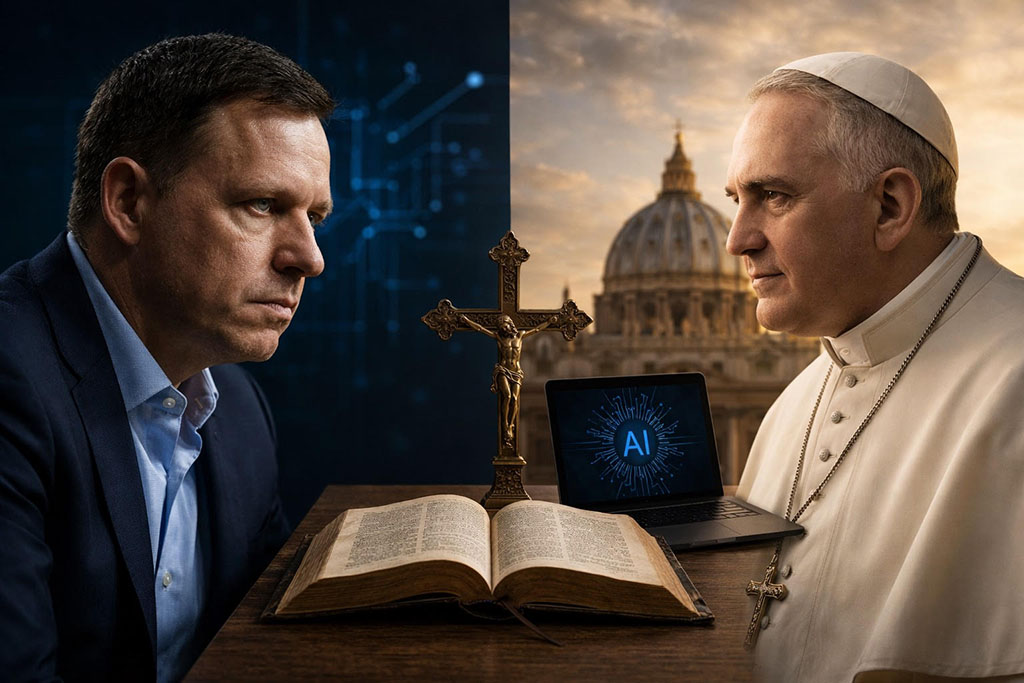
Peter Thiel in Rome opened a question that is changing the world: who controls the future – technology or morality?
28.03.2026Rome, March 2026 — In the silence of closed halls, without cameras, without phones, and without the public, American billionaire and founder of Palantir, Peter Thiel, held a series of lectures that shook the intellectual and political circles of Europe. The topic – the Antichrist.
At first glance, it is a theological concept deeply rooted in Christian tradition. However, in Thiel’s interpretation, the Antichrist is not a religious figure from apocalyptic texts, but a contemporary political and technological phenomenon.
This reinterpretation, delivered in the very heart of the Catholic world, right next to the Vatican, opened a much broader question: are we witnessing the formation of a new ideological conflict between technological elites and traditional institutions?
Secret gathering that concerned Rome
The four-day event was organized as an exclusive, closed-type gathering, accessible only to selected participants. The media had no access, the content of the lectures was not published, and participants were forbidden from using mobile phones or making any recordings.
This level of discretion raised suspicion and concern, especially considering the political and ideological weight of the organizer himself.
Additional controversy was caused by the fact that certain Catholic institutions initially linked to the event publicly denied any formal role in its organization.
The Antichrist as a global system
According to interpretations that leaked to the public, Thiel sees the Antichrist not as an individual, but as a system – a potential global structure of power that, under the pretext of peace and stability, could lead to the creation of a unified world government.
In that context, he considers contemporary tendencies toward regulating technology, especially artificial intelligence, to be particularly problematic.
For Thiel, such regulation is not protection of humanity, but a possible mechanism of control.
The Vatican on the opposite side
This position directly clashes with the stance of the Catholic Church.
In recent years, the Vatican has increasingly warned about the risks of uncontrolled technological development, insisting on ethical standards and regulatory frameworks. The focus is on protecting human dignity in the era of rapid technological advancement.
That is precisely why Thiel’s lectures in Rome were perceived as a kind of challenge – not only theological, but also political.
Some theologians and analysts went a step further, evaluating his ideas as a form of modern political theology that potentially undermines the existing order.
Technology as a new ideology
Peter Thiel is not a classical academic or theologian. He is one of the most influential figures in the modern technology industry, co-founder of PayPal and a key figure in Palantir, a company that develops software solutions for state security structures.
His influence goes beyond business.
As a political actor, Thiel is connected with conservative circles in the United States and Europe, and his financial and ideological engagement makes him one of the most significant figures in contemporary debates about the relationship between technology and power.
Because of this, his views do not remain at the level of theory – they have the potential to shape concrete policies.
A conflict that goes beyond Rome
The event in Rome shows that the world is entering a new phase.
On one side are technological elites advocating accelerated development and minimal restrictions. On the other side are institutions insisting on regulation, ethics, and social responsibility.
At the core of this conflict lies a simple but crucial question:
who has the right to define the limits of technological development?
Will it be the market and innovators – or society through its institutions?
A signal of a new era
Peter Thiel’s lectures in Rome will likely not be remembered for their specific conclusions, which remained hidden from the public.
But they will be remembered as a symbol.
A symbol of the moment when technology, religion, and politics collided in an open way.
And perhaps even more importantly – as the beginning of a new struggle for control over the future.
/ / /
"Standard Prva" LLC Bijeljina is a company registered in Bijeljina at the District Commercial Court in Bijeljina. Company’s activities are accountancy, repurchases of receivables, angel investing and other related services. Distressed debt is a part of the Group within which the company repurchases the receivables, which function and are not returned regularly.
Lawyer’s Office Stevanović is the leading lawyer’s office in the region with the seat in Bijeljina. The LO abbreviation represents Lawyer’s Office of Vesna Stevanović and Lawyer’s Office of Miloš Stevanović.
Contact for media press@advokati-stevanovic.com or via telephone 00 387 55 230 000 or 00387 55 22 4444.