When Giants Buy Each Other – UniCredit Attempts to Take Over Commerzbank
22.04.2026In the modern European financial architecture, consolidation is no longer a matter of choice but of necessity. The latest example comes from the heart of the European Union’s banking system, where the Italian banking giant UniCredit has openly expressed interest in acquiring Germany’s Commerzbank. This move is not an isolated case, but part of a broader trend in which large financial institutions seek to increase their resilience, market share, and profitability through strategic mergers and acquisitions.
At first glance, the idea of merging two systemically important banks from two key eurozone economies seems logical. UniCredit has for years been striving to strengthen its position in Central and Western Europe, while Commerzbank, despite stabilizing after the financial crisis, is still searching for a long-term sustainable business model that would make it more competitive with global banking giants. However, as in most transactions of this kind, economic logic collides with political reality.
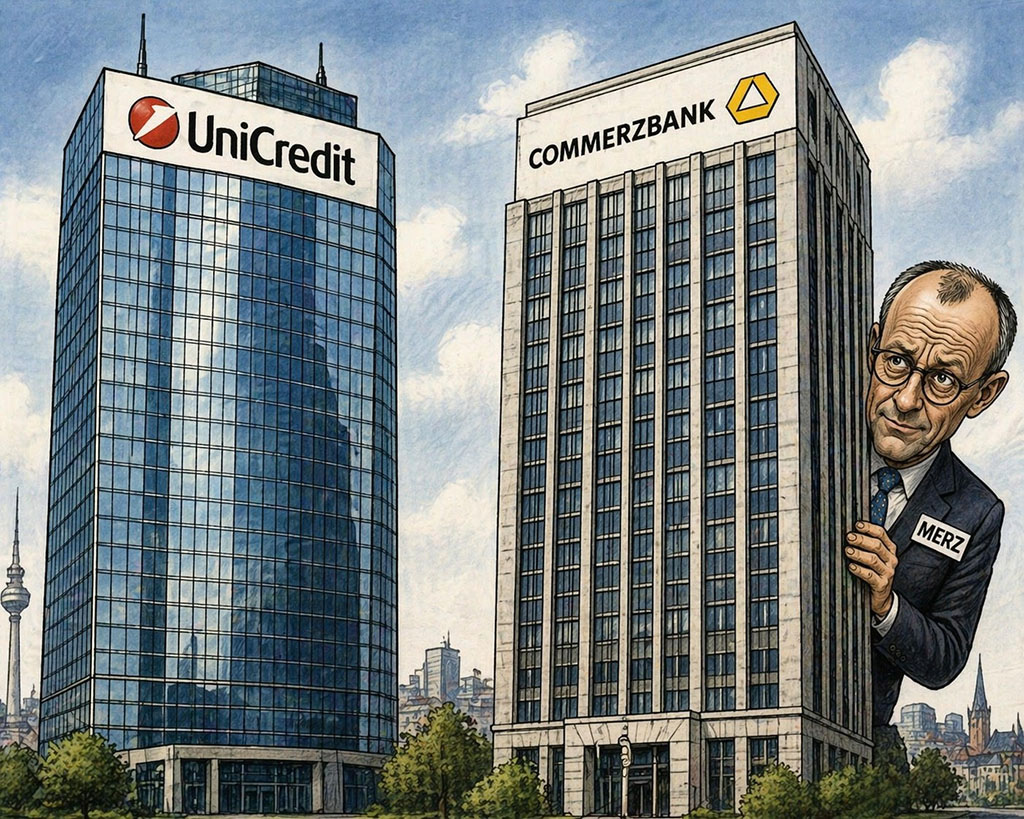
It is precisely in this space between markets and politics that a key figure emerges – German Chancellor Friedrich Merz. His position further complicates the entire process, not only because of the political weight of his office, but also due to his personal and professional background in the financial sector. Merz has long been closely connected with the banking and investment industry, making his stance on such transactions particularly scrutinized by both the markets and the public.
According to available information, Merz has taken a reserved but not entirely closed stance toward the possibility of a Commerzbank takeover. On one hand, he has clearly emphasized the need for “strong European banks” capable of competing with global players, which implicitly supports the idea of consolidation. On the other hand, he has simultaneously pointed to the importance of preserving the stability of Germany’s financial system, protecting jobs, and safeguarding the country’s strategic interests.
His statement that “Germany needs strong banks, but not at any cost” best illustrates the balance he is trying to achieve. In doing so, Merz effectively leaves room for regulators and the market to assess the justification of the transaction, while maintaining political control over the final outcome. In practice, this means that no major banking acquisition of this kind can be carried out without implicit or explicit political approval.
Such an approach aligns with Germany’s long-standing economic doctrine, where the state, although it does not formally intervene directly in market processes, retains strong influence when it comes to strategic sectors. Banking, as the lifeblood of the economy, undoubtedly falls into this category.
On the other side, UniCredit presents arguments of efficiency and synergy. In an era of increased regulatory requirements, digital transformation, and pressure on profit margins, banks are facing the need to optimize costs and expand their scale. Acquiring Commerzbank would give UniCredit access to one of Europe’s strongest industrial markets, with the potential for significant operational savings through system integration, reduction of duplicated functions, and rationalization of the business network.
However, such synergies often come with a high social cost. Experience from previous banking mergers shows that restructuring almost always involves workforce reductions, branch closures, and a redefinition of client relationships. This represents a key point of resistance, especially in Germany, where the social component of the economy enjoys strong institutional protection.
From a legal perspective, the potential transaction would face a multi-layered regulatory framework. The European Central Bank, as the supervisory authority for systemically important banks, would play a key role in assessing the stability and sustainability of such a merger. At the same time, the European Commission would analyze, through competition protection rules, whether such concentration would disrupt market balance, particularly in corporate and investment banking segments. National regulators, including Germany’s BaFin, would further evaluate the implications for the domestic market.
What makes this case particularly interesting is the broader context of European banking. Unlike the United States, where a handful of large national banks dominate, the European market remains fragmented. This fragmentation reduces the global competitiveness of European banks. In that sense, UniCredit’s attempt can also be seen as a test of the European Union’s political will to finally enable the creation of truly pan-European banking champions.
Still, the key dilemma remains the same: will Europe choose economic efficiency or the preservation of national financial identities? In that balance, Chancellor Merz’s stance could prove decisive—not as a formal decision, but as a political signal to regulators, markets, and the actors involved in the transaction.
For the business community in the region, including Bosnia and Herzegovina, such processes have an indirect but significant impact. The consolidation of large banks often leads to changes in credit policy, access to financing, and strategic priorities, which in turn affect markets where these banks operate through subsidiaries or partnerships.
In conclusion, UniCredit’s attempt to acquire Commerzbank is not merely a business transaction—it is a reflection of the relationship between capital and politics in modern Europe. At a time when capital seeks security and markets demand efficiency, such moves become inevitable. It remains to be seen whether the regulatory and political framework will keep pace with this dynamic or slow it down in order to protect the existing order.
/ / /
"Standard Prva" LLC Bijeljina is a company registered in Bijeljina at the District Commercial Court in Bijeljina. Company’s activities are accountancy, repurchases of receivables, angel investing and other related services. Distressed debt is a part of the Group within which the company repurchases the receivables, which function and are not returned regularly.
Lawyer’s Office Stevanović is the leading lawyer’s office in the region with the seat in Bijeljina. The LO abbreviation represents Lawyer’s Office of Vesna Stevanović and Lawyer’s Office of Miloš Stevanović.
Contact for media press@advokati-stevanovic.com or via telephone 00 387 55 230 000 or 00387 55 22 4444.